AUTHOR
Guardare Announces Strategic Partnership with Virtuo Group to Support Texas Department of Information Resources (DIR) Contract
Read More ->.svg)



Most security issues do not start as major incidents.
They start as small gaps.
A device that is not enrolled in MDM.
An old account that still works.
A disabled user still sitting in active groups.
A third-party app that was approved months ago and never reviewed again.
An endpoint tool that is installed, but not actually enforcing the policy the team thinks it is enforcing.
None of those findings sound dramatic on their own.
That is part of the problem.
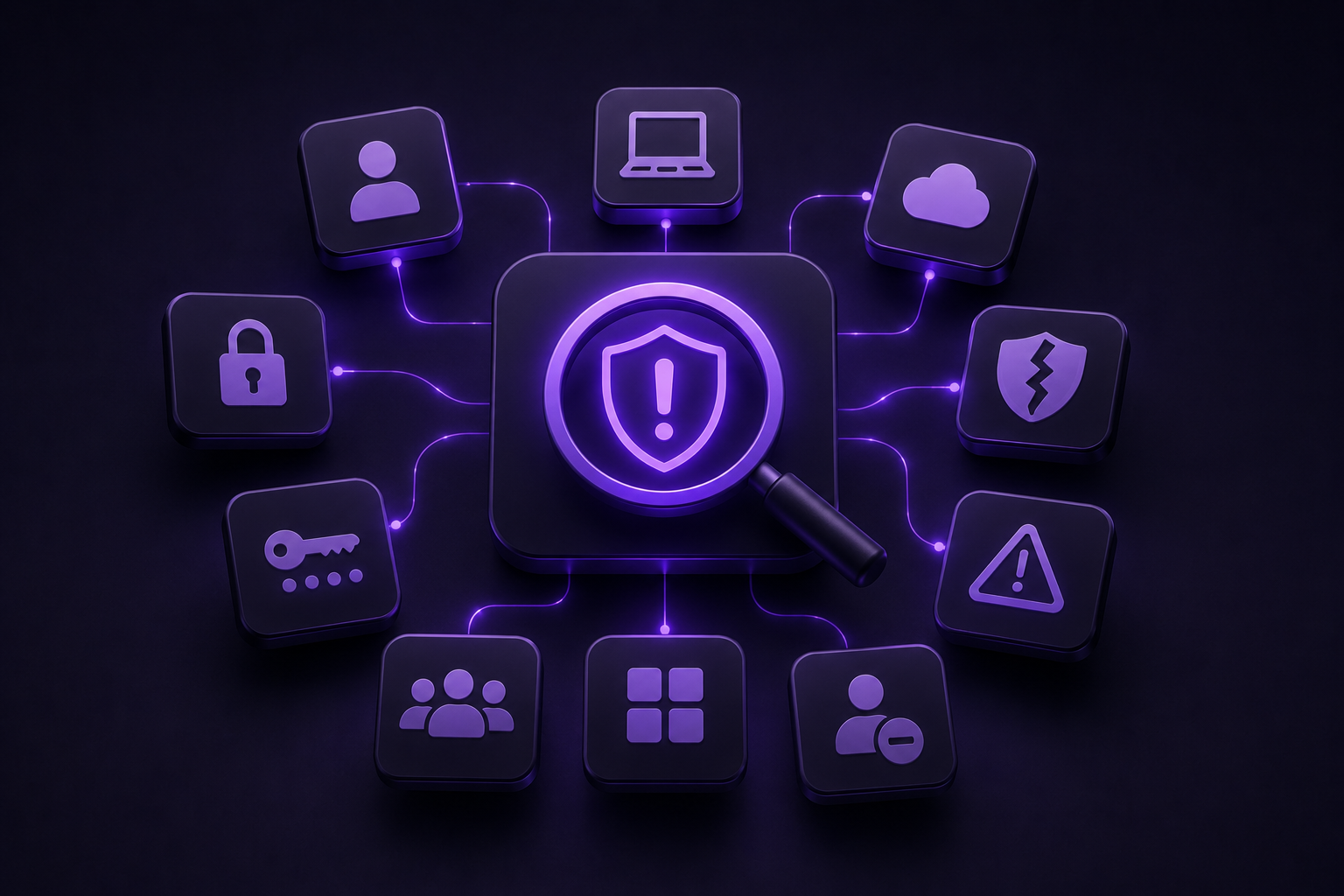
Guardare has released a new report and infographic highlighting the top ten security issues we have seen most often across customer environments so far in 2026. These are the kinds of issues that usually sit between teams, tools, and ownership lines. They are not always obvious. They do not always trigger a high-severity alert. In many cases, they look like normal IT cleanup work.
But attackers do not care what category a finding belongs in.
They care whether it gives them a path.
A lot of security programs are still built around the idea that the biggest risks will announce themselves clearly.
A critical CVE.
A malware alert.
A phishing campaign.
A failed login storm.
A suspicious file hash.
Those things matter. No question.
But many real attack paths are built from issues that look less urgent when viewed alone. A stale account may not seem like a major problem. An unmanaged device may look like an asset inventory issue. An older authentication setting may feel like technical debt. A third-party app without a verified publisher may sit quietly in a SaaS console for months.
Individually, each one might get pushed down the list.
Together, they change the risk picture.
That is what our report is meant to show. The most common security issues are not always exotic. They are often the ordinary gaps that accumulate as environments change.
Across customer environments, Guardare has repeatedly surfaced the following issues:
These findings are important because they violate the basic idea behind Zero Trust.
Do not assume trust.
Verify access.
Continuously validate the environment.
Limit unnecessary exposure.
Remove paths that should not exist.
That sounds simple in principle. In practice, it gets messy fast.
Most companies do not create these issues because they are careless.
They create them because the environment is always moving.
People join the company. People leave. Contractors get access for a project. Devices are replaced. SaaS apps are connected to get work done quickly. Security tools are installed during one phase of the business and tuned during another. Temporary settings become permanent. Old accounts remain enabled because nobody wants to break a workflow. Ownership records are incomplete because the device changed hands three times.
This is how drift happens.
It is not always dramatic. It is usually boring.
But boring does not mean safe.
A disabled user still sitting in active groups may not look urgent until you realize those groups grant access to sensitive systems. An app registration with legacy authentication settings may not look dangerous until it is tied to users with broad permissions. A device that is not enrolled in MDM may not seem like a priority until it belongs to a user with elevated access.
The risk is not just the finding.
The risk is what that finding connects to.
Most teams already have tools that show pieces of the environment.
Identity has a console.
Endpoint has a console.
MDM has a console.
SaaS apps have their own admin panels.
Vulnerability data sits somewhere else.
Security alerts live in another system.
Each tool may be telling the truth about its own slice.
That does not mean the organization has a clear view of exposure.
This is the green dashboard problem. Everything can look mostly fine when measured separately. Patch SLAs may look acceptable. Endpoint coverage may look high. Users may appear active. SaaS apps may show as approved. Devices may exist in inventory.
But attackers do not move through dashboards.
They move through relationships.
They look for the account that still works. The device nobody owns. The app nobody reviewed. The policy that was installed but not enforced. The identity permission that still exists because nobody connected it to a larger path.
That is why disconnected visibility is not enough.
Finding issues is only the first step.
The more important question is what should be fixed first.
An inactive account by itself may be a cleanup item. But if that account has old group memberships, a password found in breach data, access to a third-party application, and no clear device ownership trail, the risk changes.
Same thing with EDR.
A company may believe it has endpoint protection deployed because the agent is installed. But if the tool is in audit mode, missing key protections, or not enforcing policy correctly, that coverage may be giving the team a false sense of security.
That is the gap Guardare is built to close.
Guardare connects signals across users, devices, applications, identity, software, misconfigurations, and existing security tools. The goal is not to create another list of findings. The goal is to help teams understand what is exposed, why it matters, and what should be fixed first.
The top ten findings in this report are not surprising because they are rare.
They are important because they are common.
They show up because companies are complex. They show up because IT and security teams are busy. They show up because business decisions create technical leftovers. They show up because security tools are often deployed in pieces, owned by different teams, and reviewed through different dashboards.
None of that means a company is failing.
It means security needs a more connected view.
Attackers are not waiting for one perfect vulnerability. They are looking for combinations. A stale account. A weak authentication setting. A risky app. A device with unknown compliance. A control that is present but not effective.
That is how exposure builds.
And that is why organizations need to move beyond isolated findings and start looking at connected risk.
Guardare’s full report includes the most common issues identified across customer environments along with recommended remediation steps prioritized by risk.
To download the full report, visit www.guardare.com.
The Guard Posts is your go-to source for the latest cybersecurity news, industry events, and exclusive updates from Guardare.