What AI SOC Demos Don't Show You
There's a moment in almost every AI SOC demo where the analyst disappears.
An alert fires. The AI investigates. The AI decides. The threat is contained — or cleared — before a human has read the first line of context.
It looks fast. It looks confident. It looks like the future.
What it doesn't show you is the environment underneath.
The Demo Works. The Environment Doesn't.
Your SOC is not running on clean data.
Some endpoints are missing from MDM. EDR may be installed but still in audit mode — logging, not enforcing. Disabled users sit in active groups. SaaS apps have permissions nobody has reviewed in 18 months. Some accounts are stale. Some vulnerabilities look critical in a scanner but aren't reachable. Others look minor until you connect them to a privileged user on an unmanaged device.
That is not an unusual environment. That is a real one.
Now put an autonomous AI SOC on top of it. What is it acting on? Clean truth — or a composite of partial signals from tools that each see one slice of your business?
That's the question the demo doesn't answer.
AI doesn't fix bad visibility. It accelerates whatever visibility you already have. If the picture is incomplete, the decision may be incomplete too. Only now it arrives in seconds, expressed with confidence, and already acted on.
One hallucination in a chatbot is annoying. One hallucination inside a SOC is a suppressed alert, an isolated endpoint, a cleared incident — an automated bad decision dressed up as an automated good one.
Attackers Don't Respect Category Boundaries
Here's what makes this genuinely hard.
Attackers don't care which product owns which signal. They don't care if the weakness belongs to identity, endpoint, SaaS, cloud, vulnerability management, or a forgotten admin configuration.
They care whether it gives them a path.
A stale account doesn't look dangerous. An unmanaged device looks like an IT ticket. A third-party app with broad permissions looks like a review item. EDR in audit mode looks like a policy setting.
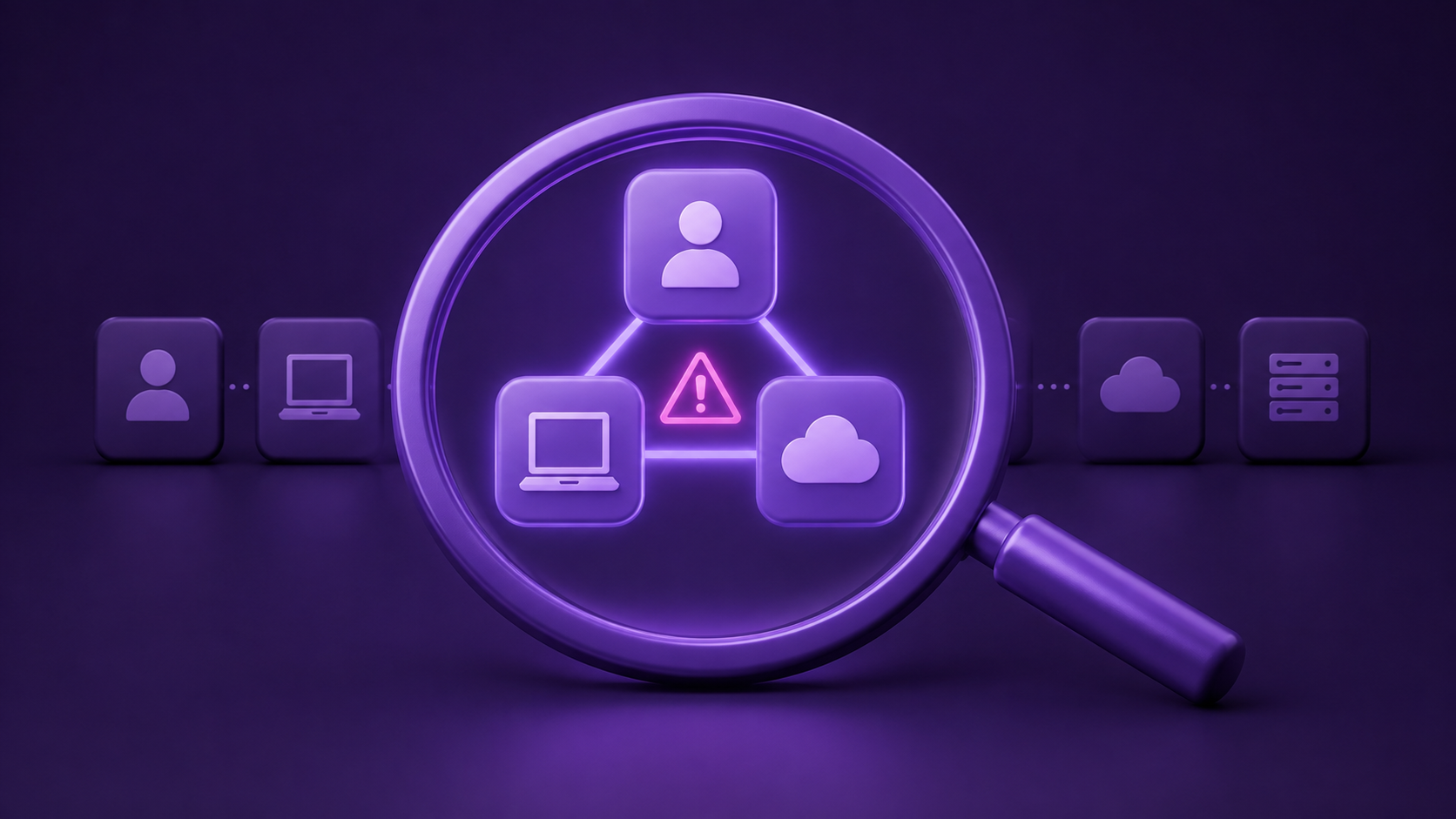
But when those things connect — stale account, unmanaged device, over-permissioned app, unenforced control — they become the path. Not individually. Together.
Most security tools show you the pieces. Very few show you what the pieces mean together.
That's what attackers exploit. Not a single misconfigured setting. The connected path that nobody was looking at as a whole.
The Right First Step Isn't Faster Response. It's Clearer Exposure.
The AI SOC pitch is about speed. Triage faster. Investigate faster. Contain faster. Close faster.
But for most organizations, speed is not the binding constraint. Visibility is.
Before you automate response, you need to know what's actually exposed. Which users carry risk. Which devices are unmanaged. Which tools are deployed but not working. Which controls are missing, misconfigured, or only partially enforced. Which vulnerabilities matter because of where they sit and what they connect to — not just because a scanner flagged them as critical.
That's not a slow process. It's a different process. One that puts the operator in control of the picture before handing any part of it to an autonomous system.
Exposure assessment before autonomous response is not a conservative position. It's the correct sequence. You wouldn't run a sprint without knowing where you're running.
What Guardare Does
Guardare helps security teams see where exposure is forming — across users, devices, software, applications, identity, vulnerabilities, misconfigurations, and security controls — before it becomes an incident.
Not more findings. Most teams already have too many findings.
Connected Exposure. The context that shows what those findings mean together, which paths are forming, and where to act first.
The analyst still decides. That's not a limitation. That's the point. A team that understands its exposure makes better decisions with AI assistance. A team that doesn't understand its exposure makes faster mistakes with AI autonomy.
Are You Ready for Autonomous Response?
Before you answer, ask five questions:
- Do you know which of your endpoints have EDR installed but not enforcing?
- Can you identify every user account with privileged access that hasn't been reviewed in 90 days?
- Do you have a complete map of third-party SaaS applications and the permissions each holds?
- Can you connect a specific vulnerability to the specific users and devices that make it reachable?
- If your AI SOC cleared an alert today, could you trace exactly what it saw — and what it didn't?
If any of those answers is uncertain, you're not ready for autonomous response. You're ready for exposure clarity.
That's where we start.
.svg)