Guardare Announces Strategic Partnership with Virtuo Group to Support Texas Department of Information Resources (DIR) Contract
Read More ->.svg)


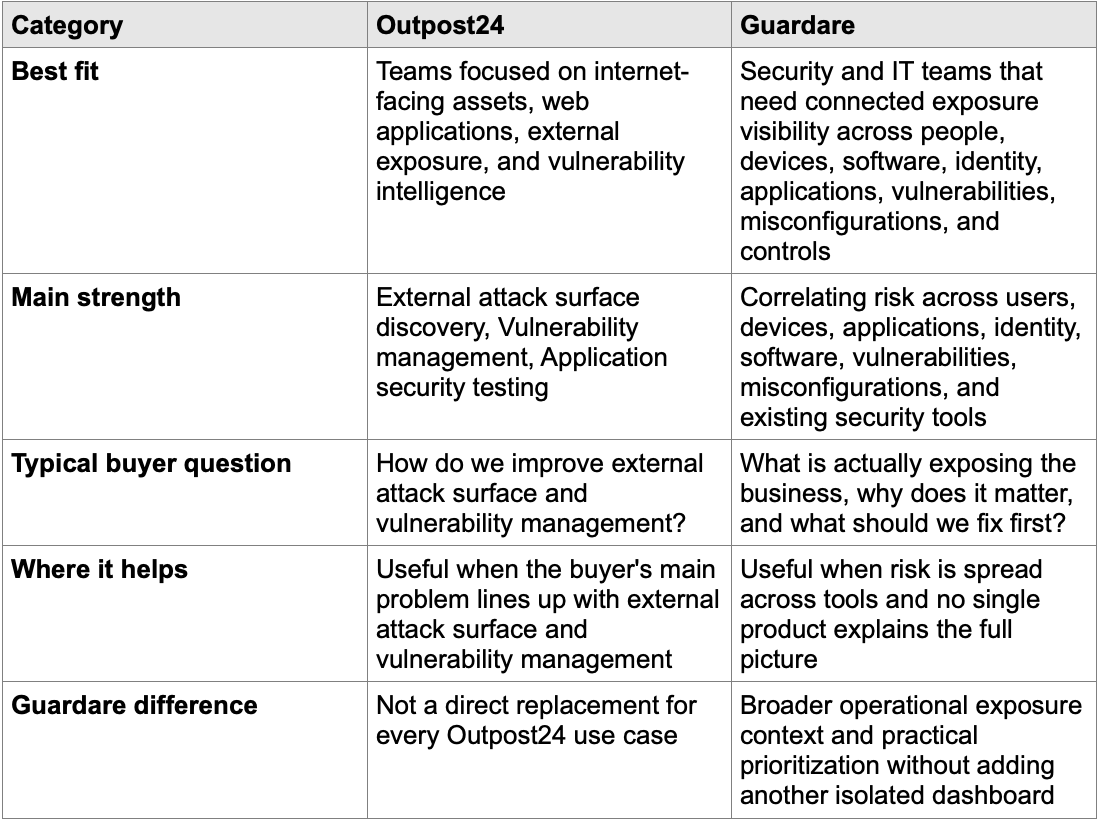
Outpost24 is a well-known name in external attack surface management, vulnerability management, web application testing, exposure intelligence, and cyber risk services. Many organizations look at Outpost24 when they are trying to improve external attack surface and vulnerability management or clean up a specific part of the security program.
That can be a real need.
But the exposure management conversation has moved beyond a single category. Security teams are no longer only asking what assets exist, what vulnerabilities are open, what alerts fired, or which tickets are waiting on an owner.
They are asking better questions:
That is where Guardare fits.
Guardare is an AI-powered Unified Exposure Management platform built to help organizations understand risk across users, devices, applications, identity, software, misconfigurations, vulnerabilities, and existing security tools. It does not try to replace every tool in the stack. It helps explain what all of those tools mean together.
Outpost24 can be a strong option for external attack surface management, vulnerability management, web application security, and exposure intelligence, but buyers often look at alternatives when the problem starts to stretch beyond one lane.
Security teams need context. A vulnerable system matters more when it is tied to a risky user, unmanaged device, exposed application, weak identity control, or missing security enforcement. A clean inventory is useful, but it does not automatically tell the team what the attacker can use.
Guardare helps connect those signals so the team can understand exposure instead of just collecting findings.
Most companies are not starting from zero. They already have endpoint tools, identity systems, cloud platforms, scanners, firewalls, SaaS applications, ticket queues, email security, and dashboards. The issue is that each tool tells a different story.
Guardare helps turn those disconnected stories into one exposure view.
A long list of assets, vulnerabilities, alerts, ratings, or tickets does not answer the question leaders care about most: what should we fix first?
That answer changes when identity, device posture, application access, control coverage, software risk, and business context are added.
A platform may show an exposed asset, a risky control, a vulnerable package, a weak policy, or a failed validation. That is useful. But the next questions matter just as much: who owns it, who can access it, what controls are missing, and whether the issue connects to a larger attack path.
Guardare is built around that broader context.
Executives do not need another export. They need to understand where the business is exposed, what is driving the risk, and what action will reduce it.
Guardare helps security and IT teams explain exposure in a way that is easier for leadership to understand.
Best for: Organizations that want unified exposure management across users, devices, applications, identity, software, misconfigurations, and security tools.
Why Choose Guardare Over Outpost24?
Outpost24 is known for external attack surface management, vulnerability management, web application security, and exposure intelligence. Guardare starts with a different question:
What is actually exposing the organization?
That includes vulnerabilities, but also users, devices, applications, access, misconfigurations, weak controls, unused security features, and disconnected tool data.
Strengths
Watch-Outs
Guardare is not positioned as a traditional SIEM, EDR, patch management, or MDR replacement. It is best suited for organizations that want exposure visibility, prioritization, and decision support across the tools they already use.
Best for: Teams focused on internet-facing assets and external attack surface risk.
Why it comes up in a Outpost24 comparison
IONIX often belongs in the evaluation because it addresses a nearby part of the exposure, risk, operations, validation, or remediation problem. The key is whether that specific strength matches the buyer's real need.
Strengths
Watch-Outs
IONIX is relevant for outside-in exposure, but internal context often decides what matters most.
Best for: Teams measuring outside-in cyber posture across vendors, partners, suppliers, or their own external footprint.
Why it comes up in a Outpost24 comparison
SecurityScorecard often belongs in the evaluation because it addresses a nearby part of the exposure, risk, operations, validation, or remediation problem. The key is whether that specific strength matches the buyer's real need.
Strengths
Watch-Outs
Outside-in ratings are useful, but they do not always show the internal context behind exposure or which controls should be fixed first.
Best for: Organizations that want mature vulnerability discovery, asset visibility, exposure management, and prioritization.
Why it comes up in a Outpost24 comparison
Tenable often belongs in the evaluation because it addresses a nearby part of the exposure, risk, operations, validation, or remediation problem. The key is whether that specific strength matches the buyer's real need.
Strengths
Watch-Outs
Tenable is a strong VM and exposure platform, but buyers should evaluate whether they also need a simpler cross-control view across users, devices, applications, and tool gaps.
Best for: Large organizations that need a mature platform for vulnerability management, compliance, asset inventory, and patch operations.
Why it comes up in a Outpost24 comparison
Qualys often belongs in the evaluation because it addresses a nearby part of the exposure, risk, operations, validation, or remediation problem. The key is whether that specific strength matches the buyer's real need.
Strengths
Watch-Outs
Qualys can provide a lot of coverage, but some teams still need help turning findings into a simple exposure story across identity, users, devices, SaaS, and controls.
Best for: Cloud-first teams that need visibility across cloud resources, workloads, identities, code, containers, and misconfigurations.
Why it comes up in a Outpost24 comparison
Wiz often belongs in the evaluation because it addresses a nearby part of the exposure, risk, operations, validation, or remediation problem. The key is whether that specific strength matches the buyer's real need.
Strengths
Watch-Outs
Wiz is very strong for cloud risk, but some organizations need exposure visibility that also reaches into users, endpoints, SaaS, on-prem assets, and existing security controls.
Exposure management is the practice of identifying, understanding, and prioritizing the weaknesses that create real risk. That includes vulnerabilities, but it also includes more than vulnerability data.
It can include:
Guardare helps teams move from isolated findings to unified exposure management.
Instead of asking teams to manually connect asset scans, user data, device posture, SaaS findings, identity context, software risk, and security tool outputs, Guardare brings those pieces into one risk model.
Guardare is especially useful for teams that want to understand:
Some buyers compare Outpost24 with platforms in adjacent categories. That can include external attack surface management, vulnerability management, security validation, SIEM, XDR, MDR, workflow automation, cyber risk quantification, or remediation tools.
Guardare should not be positioned as a direct replacement for every one of those categories.
Instead, Guardare helps answer a different question.
A scanner may show what is vulnerable. A SIEM may show what happened. An MDR provider may help investigate activity. A workflow platform may route tickets. A validation platform may prove that a control failed. Guardare is focused on understanding exposure before it turns into an incident.
The tools can work together. Detection and response tools can show what is happening. Guardare can help reduce the conditions that make those incidents more likely.
Outpost24 may be a strong fit when:
Guardare is a better fit when:
When comparing Outpost24 competitors, ask:
