Guardare Announces Strategic Partnership with Virtuo Group to Support Texas Department of Information Resources (DIR) Contract
Read More ->.svg)


There is a reason CyberProof shows up in these evaluations.
It has a clear place for organizations that want managed detection, response, threat intelligence, and SOC support. Buyers usually bring it into the conversation because they are trying to improve managed security services and detection operations, not because they woke up one morning wanting another security product in the stack.
That distinction matters.
Most teams already have tools. They have endpoint protection, identity systems, cloud consoles, scanners, ticket queues, email security, firewalls, and dashboards everywhere. The problem is not always that they lack another source of data.
The problem is that nobody can answer the simple question fast enough.
What is actually exposing us?
That is where the CyberProof conversation usually becomes more practical. CyberProof may be strong around MDR, SOC services, threat intel, and incident response support. For some organizations, that is exactly the missing piece. For others, the bigger issue is more basic. They need to understand how risk forms across users, devices, applications, identity, software, misconfigurations, vulnerabilities, and the controls they already own.
That is the gap Guardare is built around.
Guardare is not trying to be another noisy dashboard. It is built to show how exposure comes together across the environment, where the risk is actually building, and what a team should fix first.
A lot of security evaluations start too broadly.
Someone says they need an exposure management platform. Then every vendor with a risk score, a graph, a scanner, a dashboard, or an automation engine gets pulled into the same spreadsheet.
That is how teams end up comparing things that solve different problems.
CyberProof is usually relevant when a buyer is focused on managed security services and detection operations. That can be important. But exposure management is bigger than one category.
A stale account can matter.
A device outside MDM can matter.
A third-party SaaS app with broad permissions can matter.
A vulnerable system can matter more or less depending on who owns it, whether it is managed, whether EDR is enforcing, whether the asset is reachable, and whether the identity path around it is weak.
That is the real work.
Not collecting findings. Not producing a prettier report. Understanding what is connected.
Teams look for CyberProof alternatives when they want a different starting point. Sometimes they want something lighter. Sometimes they want something more operational. Sometimes they want a platform that security and IT can both use without turning every issue into a months-long enterprise project.
Guardare is a strong fit when the buyer wants to see exposure across people, devices, and software, then connect that view to practical remediation.
Guardare is built for the messy middle of security.
That is where most real risk lives.
Not neatly inside vulnerability management. Not neatly inside endpoint. Not neatly inside identity. Not neatly inside SaaS or cloud.
Attackers do not care which product category a weakness came from. They care whether it gives them a path.
Guardare helps teams find those paths earlier by connecting signals like:
Some of those findings do not look dramatic by themselves.
That is the point.
A stale account is easy to ignore. An unmanaged device can look like an IT hygiene issue. A misconfigured app can look like a small setting. But when those things connect, they start to look like a real path into the business.
Guardare helps make that visible.
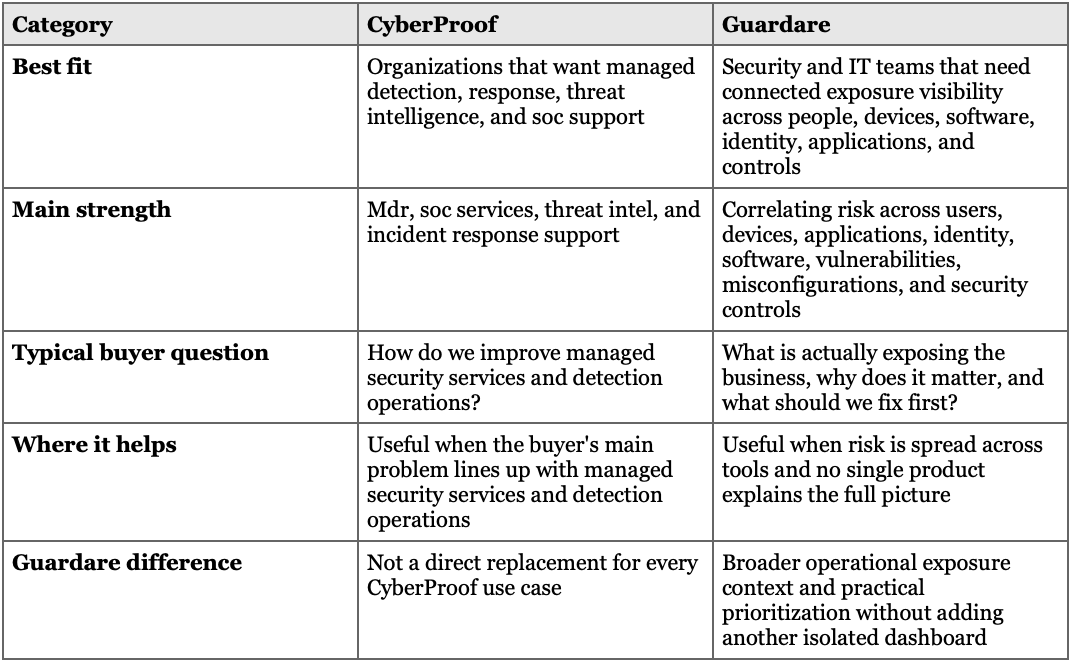
Guardare should be on the list for any team trying to move from disconnected findings to connected exposure management.
The value is not just showing more issues. Most organizations already have enough issues.
The value is showing which issues actually matter because of how they relate to people, devices, applications, identity, software, vulnerabilities, misconfigurations, and deployed controls.
That is a different conversation from a scanner export or a generic risk score.
Guardare is especially useful for teams that need to explain exposure clearly to IT, security, and leadership. It helps turn scattered signals into a simpler view of where the business is exposed and what needs to happen next.
Tenable is one of the best-known names in vulnerability and exposure management. It makes sense for teams that want mature scanning, asset coverage, vulnerability prioritization, and an established enterprise platform. The tradeoff is that buyers still need to decide how much of the exposure story sits outside vulnerabilities alone.
Qualys is a mature option for vulnerability management, asset discovery, compliance, patching, and related security operations. It is often a strong fit for teams that want a broad operational platform. Where teams may look elsewhere is when they need simpler connected context across identity, devices, SaaS, and control gaps.
Rapid7 is often considered when teams want vulnerability management tied more closely to security operations. It can be useful for remediation projects, cloud risk, and detection-oriented workflows. For buyers focused specifically on unified exposure across users, devices, applications, and controls, Guardare may be more direct.
Brinqa is a strong option for enterprises that need to normalize large amounts of security, vulnerability, asset, and business context data. It belongs in large cyber risk conversations. Some teams, though, need a more practical exposure layer before they need a larger risk data program.
XM Cyber is relevant for attack path management and understanding how attackers could reach critical assets. It is valuable when path modeling is the core need. Guardare is different because it also focuses on everyday exposure cleanup across users, devices, identity, applications, software, and controls.
Reach Security is relevant when teams want to optimize existing controls and understand where security tools are underused or misconfigured. That is a real problem. Guardare takes a broader approach by tying control gaps to the wider exposure picture.
Nucleus Security is a practical option for vulnerability aggregation and remediation operations. It helps teams bring scanner findings into one place and reduce backlog noise. Guardare is broader when the issue is not just vulnerability data, but connected exposure across the environment.
Start with the problem, not the category.
If the problem is scanner consolidation, look hard at vulnerability management and aggregation platforms.
If the problem is attack path validation, look at validation and attack path tools.
If the problem is ticket routing, ownership, and workflow, look at ITSM and remediation platforms.
If the problem is executive risk reporting, look at cyber risk quantification platforms.
But if the problem is that your team cannot clearly see how users, devices, applications, identity, software, vulnerabilities, misconfigurations, and controls come together into real exposure, Guardare should be high on the list.
That is the buying question that matters.
Not which platform has the biggest category story.
Which platform helps you see what attackers can actually use?
