Guardare Enters UKI Market Through Strategic Partnership
Read More →

Fable 5, Mythos, and AI Accelerated Exploitation

A buyer's guide for security teams evaluating how AI-assisted attackers may use advanced models to find, connect, and exploit exposure faster.
10 Minutes
read 

Table of Contents

What are Fable 5 and Mythos?

Why these models matter to cybersecurity

The real risk: faster exploitation, not magic exploitation

Why disconnected security data creates an attacker advantage

What organizations should look for in a defensive platform

How Guardare helps close the gap

Example: from scattered findings to exploitable path

Buyer checklist

FAQs

What Are Fable 5 and Mythos?

Fable 5 and Mythos are advanced AI models associated with Anthropic's next generation of frontier AI systems. Based on public reporting, Fable 5 is the more broadly available version, while Mythos or Mythos 5 refers to a more restricted model class with stronger cyber capabilities and tighter access controls.

The reason these models drew attention is simple: they appear to be very good at complex technical reasoning.

That includes software engineering, code review, vulnerability research, long-context analysis, and multi-step problem solving. Those capabilities are useful for defenders, developers, researchers, and security teams.

They are also useful for attackers.

The concern is not that Fable 5 or Mythos gives every attacker instant zero-day powers. That is usually the wrong way to think about AI security risk. The more realistic concern is that these systems can help attackers move faster through work that used to take more time, more skill, or more manual effort.

An attacker may use an advanced AI model to understand vulnerable software, summarize exploit paths, reason through misconfigurations, analyze public CVEs, write proof-of-concept logic, or identify which exposed system is most worth attacking first.

That changes the economics of exploitation.

Why These Models Matter to Cybersecurity

For years, defenders have relied on a basic assumption: attackers have limited time.

  • They have to research targets.
  • Find exposed systems.
  • Understand vulnerable software.
  • Test exploit paths.
  • Chain weaknesses together.
  • Figure out which organizations are worth pursuing.

AI compresses that work.

A model like Fable 5 or Mythos does not need to be perfect to create risk. It only needs to help attackers move faster than the average organization can patch, prioritize, or understand its own exposure.

That is the important shift.

The risk is not just "AI can find vulnerabilities."

The risk is:

  • AI can help attackers understand environments faster
  • AI can help turn public information into attack plans faster
  • AI can reduce the skill required to exploit common weaknesses
  • AI can help chain identity, device, and software gaps together
  • AI can make small teams of attackers operate like larger teams
  • AI can increase the speed between discovery and exploitation

For defenders, that means the window between "we have an issue" and "someone can use this against us" is getting smaller.

The Real Risk: Faster Exploitation, Not Magic Exploitation

It is easy to overstate the threat.

Fable 5 and Mythos are not magic buttons. They do not automatically breach companies. They do not remove the need for access, infrastructure, testing, or attacker decision-making.

But they can make the boring parts of attack preparation much faster.

That matters because most companies are not breached through exotic movie-level attacks. They are breached through known weaknesses that were visible but not connected.

  • Exposed remote access
  • Unpatched internet-facing software
  • Weak or missing MFA
  • Breached employee credentials
  • Disabled users still in active groups
  • Devices not enrolled in MDM
  • EDR running in audit mode
  • Over-permissioned identities
  • Third-party applications with weak controls
  • Cloud misconfigurations

These are exactly the types of issues an AI-assisted attacker can help organize, reason through, and prioritize.

The attacker's advantage is not just finding a vulnerability.

It is finding the right combination of weaknesses before the defender does.

Why Disconnected Security Data Creates an Attacker Advantage

Most organizations already have the data they need.

The problem is that it lives in too many places.

  • The vulnerability scanner sees vulnerable software.
  • The identity platform sees risky users.
  • The MDM tool sees unmanaged devices.
  • The EDR console sees protection gaps.
  • The cloud dashboard sees misconfigurations.
  • The dark web tool sees breached credentials.
  • The ticketing system sees remediation status.

Each tool sees part of the picture.

Attackers do not care which tool owns which finding. They care about the path.

That is why AI-assisted exploitation is such a serious issue for security teams. If an attacker can use AI to connect the dots faster than the organization can, the company is left defending individual findings while the attacker is pursuing a connected path.

That is the gap Guardare is built to close.
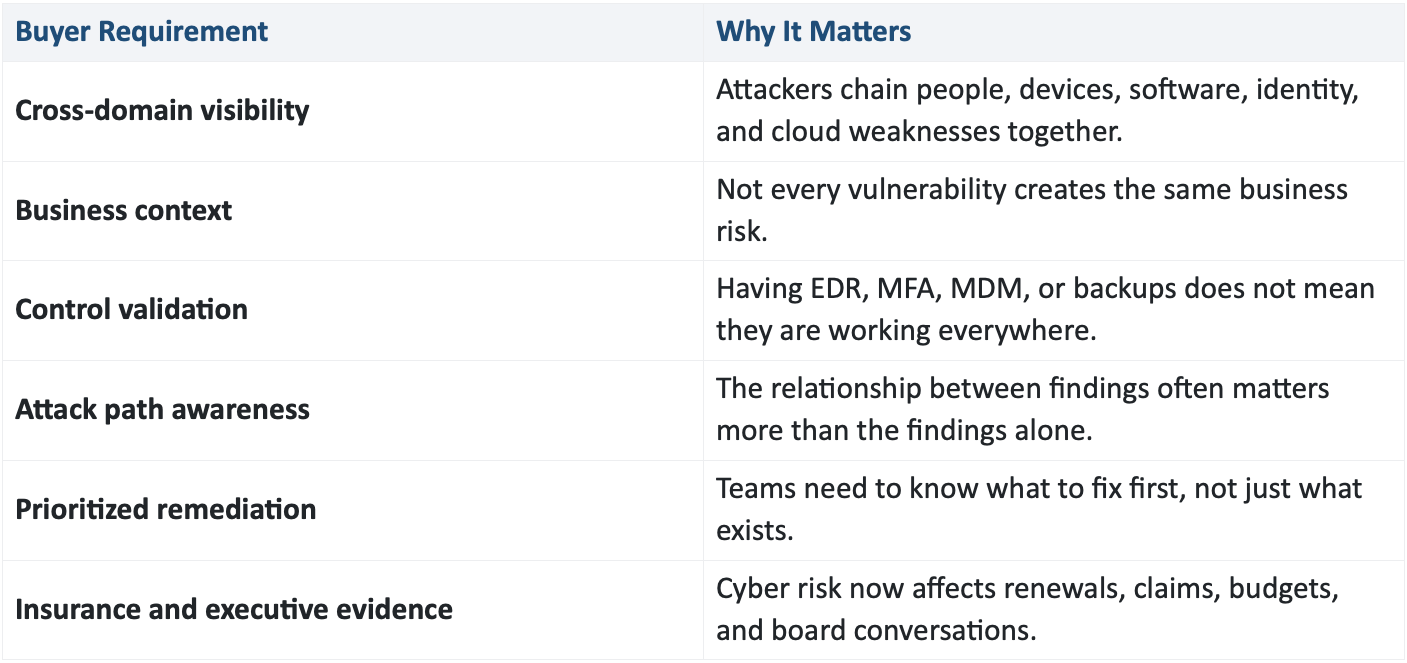
What Organizations Should Look For in a Defensive Platform

How Guardare Helps Close the Gap

Guardare helps organizations understand exposure the way an attacker would, but for defense.

It connects data across:

  • People
  • Devices
  • Software
  • Identities
  • Cloud assets
  • Applications
  • Security controls
  • Known vulnerabilities
  • Misconfigurations
  • Breached credentials

The value is not just collecting more findings.

Most organizations already have plenty of findings.

The value is showing how those findings relate to each other and which combinations create the most realistic path to business impact.

Guardare helps answer questions like:

  • Which vulnerable systems are tied to critical business workflows?
  • Which users with breached credentials still have meaningful access?
  • Which devices are unmanaged or missing ownership?
  • Which security tools are deployed but not enforcing protection?
  • Which identities have risky permissions?
  • Which cloud or application gaps increase the blast radius?
  • Which issues should be fixed first to reduce actual exposure?

That matters in a Fable 5 or Mythos-class world because attackers are using better tools to move faster.

Defenders need better context to move smarter.

Example: From Scattered Findings to Exploitable Path

A company has several issues across its environment.

  • One user has credentials found in a breach.
  • That same user has access to a finance application.
  • The user's laptop is not enrolled in MDM.
  • EDR is installed but running in audit mode.
  • A legacy remote access service is still exposed.
  • The application supports vendor payments.

In most companies, these show up as separate findings.

  • One ticket for the password issue.
  • One identity finding.
  • One MDM gap.
  • One endpoint configuration issue.
  • One exposed service.
  • One business application owner who may not even know the risk exists.

An AI-assisted attacker does not see five tickets.

They see a path.

Guardare connects those findings and shows the organization what they mean together. The risk is no longer "one breached password" or "one unmanaged device." It is a realistic chain from credential exposure to access, from access to an unmanaged endpoint, from that endpoint to weaker protection, and from there to a finance workflow that could create business disruption.

That is the difference between tool data and exposure intelligence.

Buyer Checklist

When evaluating a platform for AI-era exposure defense, buyers should ask:

  • Does it connect people, devices, software, identity, cloud, and controls?
  • Does it show relationships between findings?
  • Does it identify which exposures could become business impact?
  • Does it validate whether controls are actually working?
  • Does it recommend specific fixes?
  • Does it help prioritize based on risk, not just severity?
  • Does it support insurance and executive reporting?
  • Does it help reduce the attacker's path, not just count vulnerabilities?

If the answer is no, the organization may still be operating at dashboard speed while attackers are moving at AI speed.

FAQs

1. Is Fable 5 or Mythos a hacking tool?
Not exactly. They are advanced AI models with strong reasoning and software capabilities. The concern is that those same capabilities can be used for cyber research, vulnerability analysis, exploit planning, or attack acceleration.
2. Does this mean every company is suddenly at risk from AI-generated zero-days?
No. The more immediate risk is faster exploitation of known or discoverable weaknesses. Most organizations are still exposed through common gaps like missing MFA, exposed services, unmanaged devices, weak identity controls, and unpatched software.
3. Why does Guardare matter in this context?
Guardare helps defenders connect the same dots attackers are trying to connect. It brings together people, devices, software, identity, cloud, and control data so teams can see which issues combine into real exposure.
4. How is this different from vulnerability management?
Vulnerability management usually focuses on software flaws and severity scores. Guardare looks more broadly at exposure. A medium vulnerability on a critical system with weak identity controls and missing endpoint enforcement may be more urgent than a critical vulnerability on an isolated test system.
5. What should organizations do first?
Start by identifying the paths an attacker would care about most. Look for exposed systems, breached credentials, privileged users, unmanaged devices, missing controls, and vulnerable software tied to business-critical workflows. Then prioritize the fixes that remove the most realistic paths to impact.