Guardare Enters UKI Market Through Strategic Partnership
Read More →

Best Trend Micro Competitors and Alternatives for 2026

Trend Micro is a well-known name in endpoint security, XDR, cloud workload security, email security, attack surface risk management, and threat detection.
11 Minutes
read 

In this guide, you'll learn:

  • Why organizations compare Trend Micro against broader exposure management platforms.
  • Where Trend Micro may be useful when the main goal is using a broad security platform across endpoint, cloud, and email.
  • How risk changes when user context, device posture, software exposure, identity access, and security control coverage are viewed together.
  • How Guardare helps teams ask plain-English questions about their own environment while keeping sensitive security data inside a trusted system.
  • How Trend Micro compares to Guardare and alternatives like Palo Alto Networks, CrowdStrike, SentinelOne Singularity, Microsoft Defender Vulnerability Management, Wiz.
  • When Trend Micro may still be the right choice.
  • When Guardare can help buyers move from more data to better decisions.

Trend Micro can be the right tool when a team has a focused problem around using a broad security platform across endpoint, cloud, and email.

That can be a real need.

But real exposure rarely stays inside one product category. A vulnerable system may sit on an unmanaged device. That device may belong to a risky user. The user may have broad SaaS access. The endpoint tool may be installed but not enforcing. The risk lives in the relationship between those facts.

That is where Guardare fits.

Guardare helps organizations read the environment as one connected system instead of a pile of separate dashboards. It looks across users, devices, software, identities, SaaS applications, vulnerabilities, cloud, on-prem infrastructure, and controls to explain where exposure is coming from.

Guardare also brings product-level context into the exposure story. It is trained across more than 200 security and IT products so it can help identify product misconfigurations, product best practices that are not being used, and control gaps that are easy to miss when each tool is reviewed in isolation.

Guardare is also mapped to MITRE ATT&CK and MITRE D3FEND so teams can connect likely attack paths with practical defensive actions. That means the platform is not only looking for vulnerable assets. It is helping security and IT teams understand how the organization is most likely to be attacked and which product configurations, controls, and best practices can reduce that risk in real time.

Why Companies Look for Trend Micro Alternatives

1. Trend Micro Can Be Strong But Narrow

Trend Micro is often evaluated for endpoint security, XDR, cloud workload security, email security, attack surface risk management, and threat detection. Buyers look at alternatives when the problem expands beyond that lane and starts to include people, devices, software, cloud, identity, SaaS, vulnerabilities, and control gaps.

2. More Data Does Not Always Mean Better Decisions

A dashboard can show findings, alerts, scores, paths, tickets, or validation results. That still does not answer what should be fixed first.

3. Existing Tools Often Disagree

Most teams already own endpoint tools, scanners, identity systems, firewalls, cloud platforms, ticket queues, email security, and dashboards. Guardare helps explain what those tools mean together.

This is also where Guardare's product training matters. Because Guardare understands the configuration and best-practice expectations across more than 200 security and IT products, it can help spot when a product is deployed but not configured the way the organization needs it to be.

4. Context Changes Priority

A medium issue can become urgent when it affects a privileged user, unmanaged device, exposed application, missing control, or business-critical system.

5. Executives Need a Cleaner Risk Story

Leadership needs to understand where the business is exposed, what is driving the risk, and what action reduces it. Guardare helps teams turn technical findings into plain-language decisions.

Top Trend Micro Competitors and Alternatives

1. Guardare

Best for: Teams that need connected exposure visibility across people, devices, software, identities, applications, vulnerabilities, misconfigurations, cloud, on-prem systems, and controls.

Why Choose Guardare Over Trend Micro?

Trend Micro is usually evaluated when the buyer is focused on using a broad security platform across endpoint, cloud, and email. Guardare starts with a broader operating question: what is actually exposing the organization, how do those conditions connect, and what should be fixed first?

Strengths

  • Unified visibility across users, devices, software, identity, applications, vulnerabilities, misconfigurations, and controls
  • Plain-English environment questions inside a controlled customer-specific system
  • Continuous CVE and exposure evaluation mapped to real assets and controls
  • Prioritization that accounts for user risk, device posture, software exposure, access, and control coverage
  • Executive-ready reporting that explains where risk is coming from and what is being fixed
  • Product-agnostic approach that works across mixed tools and environments
  • Trained on more than 200 security and IT products to identify product misconfigurations and product best practices that are not being used
  • Mapped to MITRE ATT&CK and MITRE D3FEND to connect likely attack paths with practical defensive actions
  • Helps translate product configuration data, control posture, and best-practice gaps into real-time defense recommendations

Watch-Outs

Guardare should not be described as a one-for-one replacement for every Trend Micro use case. It is strongest when the buyer wants broader exposure context and prioritization across the tools already in place.

2. Palo Alto Networks

Best for: Enterprises that want a broad security platform across firewall, cloud, endpoint, SOC, and automation.

Why it comes up in a Trend Micro comparison

Palo Alto Networks comes up when buyers are looking at network security, cloud security, SOC platforms, XDR, and security operations. It belongs in the conversation when that is the real buying problem, but it should be evaluated against how well it turns findings into prioritized action.

Strengths

  • Large platform footprint across network, cloud, endpoint, SOC, and threat intelligence
  • Strong fit for enterprises already standardized on Palo Alto security architecture
  • Can consolidate multiple security workflows for mature teams

Watch-Outs

  • Platform breadth can create complexity, cost, and adoption challenges if teams only need exposure clarity
  • Buyers should confirm whether the goal is platform consolidation or product-agnostic risk explanation

3. CrowdStrike

Best for: Teams that want a mature endpoint-centered security platform with strong threat detection and response.

Why it comes up in a Trend Micro comparison

CrowdStrike comes up when buyers are looking at endpoint protection, EDR, XDR, identity protection, cloud security, and managed detection. It belongs in the conversation when that is the real buying problem, but it should be evaluated against how well it turns findings into prioritized action.

Strengths

  • Known for lightweight endpoint protection, EDR telemetry, and threat detection depth
  • Broad platform footprint across endpoint, identity, cloud, exposure, and managed services
  • Strong fit where stopping active threats on endpoints is the primary requirement

Watch-Outs

  • CrowdStrike is powerful, but buyers still need to validate what it does not see outside its deployment footprint
  • Teams should confirm whether it explains cross-tool exposure or mainly strengthens the Falcon-centered operating model

4. SentinelOne Singularity

Best for: Teams that want autonomous endpoint protection and XDR capabilities with broad security telemetry.

Why it comes up in a Trend Micro comparison

SentinelOne Singularity comes up when buyers are looking at endpoint protection, EDR, XDR, identity, cloud, and data security. It belongs in the conversation when that is the real buying problem, but it should be evaluated against how well it turns findings into prioritized action.

Strengths

  • Known for autonomous endpoint protection and EDR/XDR workflows
  • Useful where malware prevention, behavioral detection, and endpoint response are primary needs
  • Broadening platform can support identity, cloud, and data protection use cases

Watch-Outs

  • Strong endpoint telemetry does not automatically equal complete exposure management across every tool and control
  • Buyers should confirm coverage gaps outside deployed agents and SentinelOne-integrated data

5. Microsoft Defender Vulnerability Management

Best for: Microsoft-centric teams that want vulnerability prioritization tied to Defender endpoint telemetry.

Why it comes up in a Trend Micro comparison

Microsoft Defender Vulnerability Management comes up when buyers are looking at vulnerability management inside the Microsoft Defender ecosystem. It belongs in the conversation when that is the real buying problem, but it should be evaluated against how well it turns findings into prioritized action.

Strengths

  • Natural fit for organizations standardized on Microsoft Defender and Entra ID
  • Useful for vulnerability insights tied to endpoint telemetry and Microsoft security workflows
  • Can reduce tool sprawl when Microsoft is already the center of security operations

Watch-Outs

  • Best value usually comes in Microsoft-heavy environments and licensing can shape adoption decisions
  • Buyers should confirm coverage for non-Microsoft assets, SaaS, network controls, and third-party security tools

6. Wiz

Best for: Cloud-first teams that need visibility across cloud environments, workloads, identities, vulnerabilities, and misconfigurations.

Why it comes up in a Trend Micro comparison

Wiz comes up when buyers are looking at cloud security posture, CNAPP, cloud risk, identity, code, and runtime cloud exposure. It belongs in the conversation when that is the real buying problem, but it should be evaluated against how well it turns findings into prioritized action.

Strengths

  • Strong cloud security posture and CNAPP reputation with broad cloud visibility
  • Useful for prioritizing toxic combinations across cloud resources, identities, vulnerabilities, and misconfigurations
  • Good fit for organizations where cloud is the center of the exposure problem

Watch-Outs

  • Cloud security depth does not replace the need for endpoint, user, SaaS, on-prem, and control validation context
  • Buyers should confirm whether they need cloud-native exposure management or broader enterprise exposure coverage

Guardare vs. Trend Micro: Quick Comparison

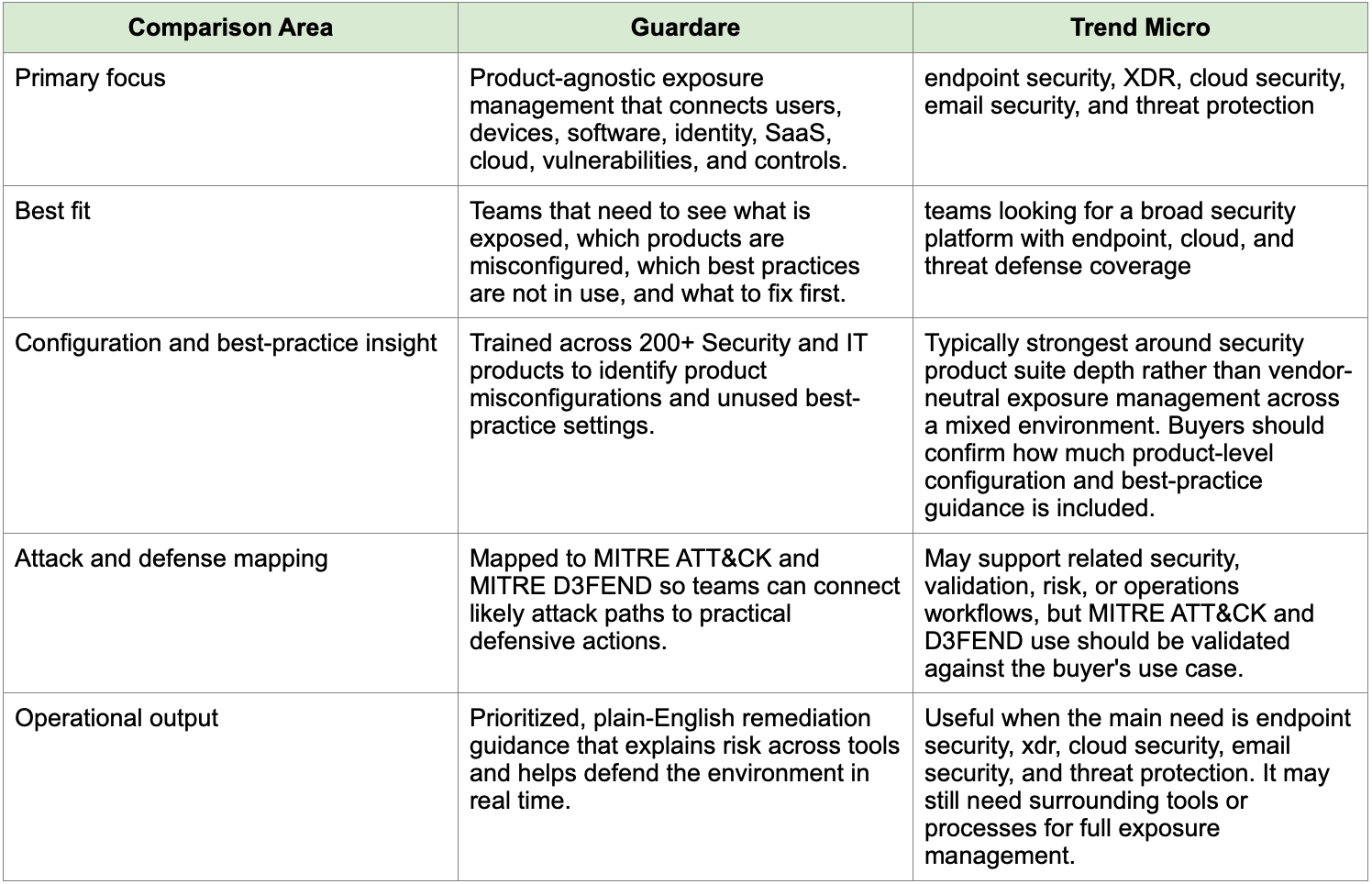
Use this table as a quick way to understand where Guardare and Trend Micro usually fit in a security program.
Trend Micro Exposure Management Alternatives

Exposure management helps teams answer a simple question that is hard to answer with separate tools: what are we exposed to, why does it matter, and what should we fix first?

In real environments, exposure can come from:

  • Unmanaged or poorly protected devices
  • Risky users and stale accounts
  • Vulnerable or unsupported software
  • Cloud and on-prem misconfigurations
  • SaaS applications with broad permissions
  • Weak or missing identity controls
  • Security tools deployed but not enforcing
  • External attack surface exposure
  • Ownership gaps that slow remediation

Guardare as a Trend Micro Alternative

Guardare should be evaluated when the buyer wants more than a endpoint security point solution. It helps teams connect the operational details that usually live in separate tools: users, devices, software, identity, cloud, on-prem assets, SaaS applications, vulnerabilities, misconfigurations, and control coverage.

It also helps teams move beyond inventory and alert review. Guardare uses product configuration knowledge, product best-practice context, MITRE ATT&CK mapping, and MITRE D3FEND defensive guidance to show where the organization is exposed, how an attacker may take advantage of that exposure, and what practical control improvements can reduce the risk.

For buyers looking at AI, the privacy model matters. Guardare gives teams a way to ask plain-English questions about their own environment without pasting asset, identity, vulnerability, or control data into public tools.

The value is not more noise. It is fewer, better decisions. Guardare keeps watching for the conditions that matter and helps security and IT teams focus time and budget on the issues most likely to reduce exposure.

Trend Micro Security Operations, Risk, and Remediation Alternatives

Some buyers compare Trend Micro with platforms in adjacent categories. That can include vulnerability management, external attack surface management, SIEM, XDR, MDR, security validation, workflow automation, cyber risk quantification, remediation tools, or security operations platforms.

Guardare should not be forced into every one of those buckets. It answers a different question. A scanner may show what is vulnerable. An MDR provider may show what happened. A workflow platform may route tickets. A validation platform may prove a path works. Guardare helps explain the exposure conditions before they turn into an incident or an endless queue of tickets.

When Trend Micro May Still Be the Right Fit

  • Your main problem is specifically using a broad security platform across endpoint, cloud, and email.
  • Your team already has a working process built around Trend Micro.
  • Trend Micro is already adopted and producing measurable value.
  • The organization needs a category-specific capability more than a broader exposure layer right now.
  • Switching would create more operational friction than benefit.

When Guardare Is the Better Fit

  • You want to see how users, devices, software, identity, applications, cloud, on-prem systems, and controls combine into exposure.
  • You want natural-language answers without creating new data leakage concerns.
  • You want defensive CVE intelligence that explains whether a new issue matters to you.
  • You want to identify product misconfigurations and unused product best practices across a broad security and IT stack.
  • You want MITRE ATT&CK and MITRE D3FEND context tied to your actual users, devices, applications, products, and controls.
  • You have too many findings and not enough clarity.
  • You need reporting that leadership can understand without reading scanner exports.
  • You need a product-agnostic approach that works across regions, tools, and infrastructure models.

How to Evaluate Trend Micro Alternatives

  1. Does the platform explain exposure, or does it mainly produce findings, alerts, scores, tickets, paths, or tests?
  2. Can it connect people, devices, software, identities, applications, vulnerabilities, cloud, on-prem systems, and controls?
  3. Does it work with the tools you already use, or does it require a broader platform switch?
  4. Can teams ask natural-language questions about their own environment in a trusted system?
  5. Does it evaluate new CVE intelligence against your actual assets and controls?
  6. Can it identify underused tools, misconfigurations, and missing enforcement?
  7. Can it identify product misconfigurations and product best practices that are not being used across the tools you already own?
  8. Does it use MITRE ATT&CK and MITRE D3FEND context to explain likely attack paths and defensive actions?
  9. Does it help operators decide what to fix first?
  10. Can executives understand the reporting without needing another technical export?

Trend Micro Alternatives FAQ

Can Guardare complement Trend Micro?
Yes. Guardare can help place cloud findings next to identity, endpoint, user, SaaS, vulnerability, and control data so teams can prioritize based on real business exposure.
What is the biggest watch-out with Trend Micro?
The biggest watch-out is treating cloud visibility as the full exposure picture. Buyers should confirm how non-cloud systems and business context are handled.
Is Trend Micro mainly a cloud security platform?
Trend Micro is usually evaluated for endpoint, email, cloud, XDR, and enterprise security platform capabilities. It can be a strong fit when cloud is the main risk surface, but most organizations still need visibility across non-cloud users, devices, SaaS, software, and controls.
Why compare Trend Micro with Guardare?
Compare the two when deciding whether the primary problem is cloud security depth or enterprise-wide exposure context. Guardare is designed to connect cloud findings with the rest of the environment.
Who should consider Trend Micro?
Trend Micro should be considered by Teams seeking a broad security platform across endpoint, email, cloud, and threat detection. Guardare should be considered when the buyer wants cloud risk connected to the rest of the security program.