Guardare Announces Strategic Partnership with Virtuo Group to Support Texas Department of Information Resources (DIR) Contract
Read More ->.svg)

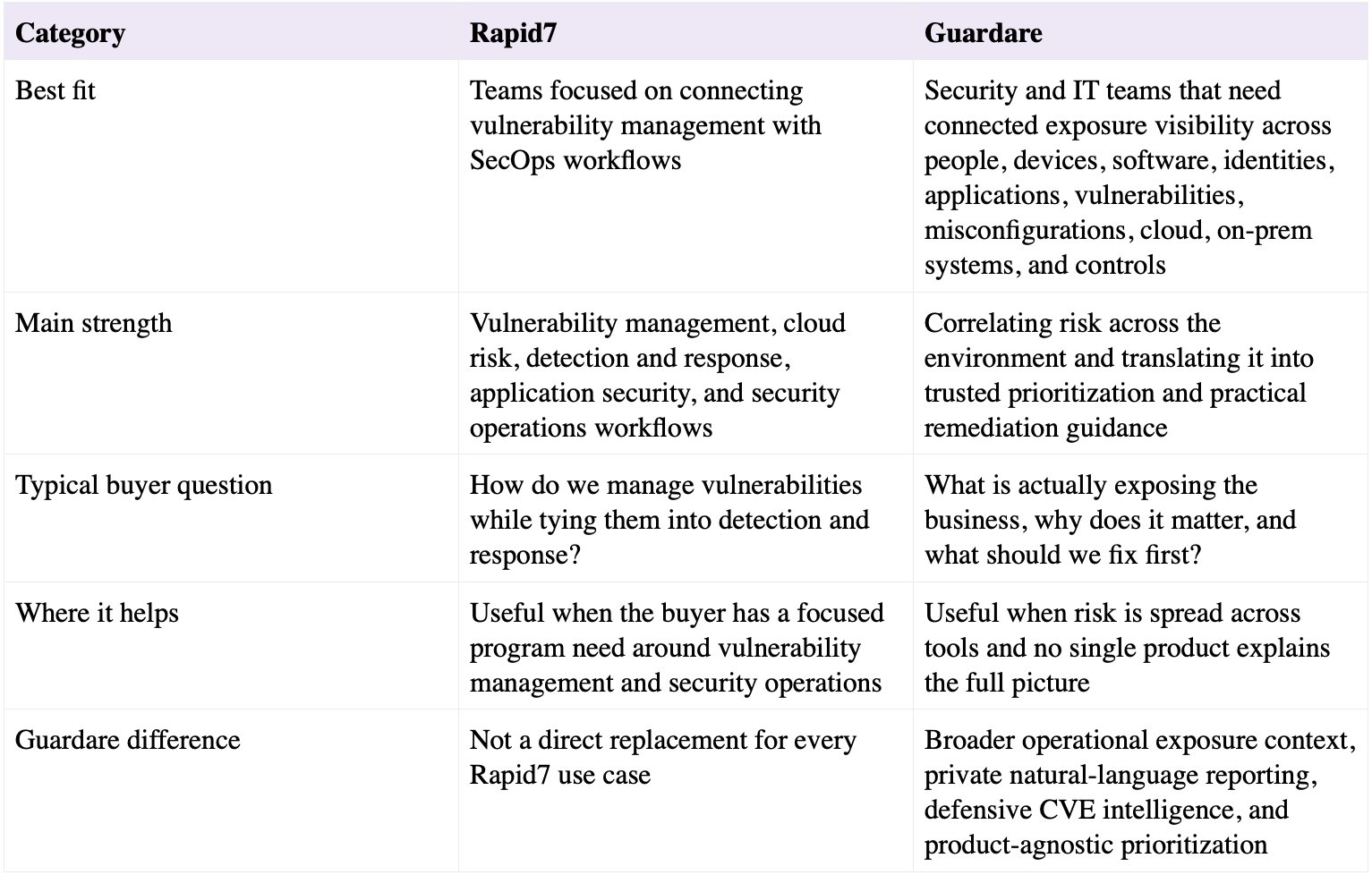
Rapid7 can be the right tool when a team has a focused problem around connecting vulnerability management with SecOps workflows.
Security data usually arrives in pieces. One tool sees the device. Another sees the identity. Another sees vulnerable software. Another sees cloud exposure. The buyer still has to decide what all of it means and what should be fixed first.
That is where Guardare fits.
Guardare helps teams move from disconnected security data to useful decisions. It brings together the environment around people, devices, software, identities, vulnerabilities, misconfigurations, cloud, on-prem systems, and tools already in place.
Rapid7 is often evaluated for vulnerability management, detection, cloud risk, and security operations. Buyers look at alternatives when they want exposure clarity without expanding into another broad platform commitment.
Peer reviews of vulnerability tools often discuss scan performance, administration, reporting, and the resources needed to keep programs running well at scale.
A remediation workflow is useful, but the right priority may depend on identity risk, device posture, software exposure, SaaS access, and control coverage from other systems.
Teams may compare alternatives when pricing, module overlap, or operational complexity starts to outweigh the value they are getting.
Rapid7 may fit vulnerability and SecOps programs. Broader alternatives come up when leaders want a product-agnostic advisor across people, devices, and software.
Best for: Teams that want trusted prioritization across people, devices, software, vulnerabilities, identity, controls, cloud, and on-prem environments.
Rapid7 is usually evaluated when the buyer is focused on connecting vulnerability management with SecOps workflows. Guardare starts with a broader operating question: what is actually exposing the organization, how do those conditions connect, and what should be fixed first?
That includes CVEs, but not only CVEs. It also includes risky users, unmanaged devices, exposed software, stale access, broad SaaS permissions, weak identity controls, underused tools, and cloud or on-prem misconfigurations.
Guardare should not be described as a replacement for a 24/7 MDR provider or incident response team. It is better positioned as the exposure intelligence layer that helps reduce avoidable risk, support security operations, and make existing tools more useful.
Best for: Organizations that want mature vulnerability discovery, asset visibility, exposure management, and prioritization.
Tenable belongs in many evaluations because it is a long-standing vulnerability management and exposure platform. It is often strongest when the buyer wants scanner depth, enterprise adoption, and a broad vulnerability program.
A strong VM platform can still leave teams asking how vulnerability data connects to user risk, SaaS permissions, device ownership, control gaps, and business-ready decisions.
Best for: Large organizations that need a mature platform for vulnerability management, compliance, asset inventory, and patch operations.
Qualys often comes up when the buyer wants a broad enterprise platform with scanning, VMDR, compliance, and patch-related capabilities.
Qualys can produce deep coverage, but buyers should test whether the output becomes easier to act on or simply becomes a larger backlog.
Best for: Microsoft-centered teams that want endpoint vulnerability management inside the Defender ecosystem.
Microsoft is often considered by organizations that already rely heavily on Defender, Intune, Entra ID, and the broader Microsoft security stack.
It may be a good fit for Microsoft-heavy environments, but mixed environments still need to understand risk across non-Microsoft tools, cloud services, users, and software.
Best for: Teams that need one place to centralize and prioritize findings from multiple vulnerability scanners.
Nucleus is often evaluated by mature VM teams that already have many scanners and need aggregation, deduplication, and remediation tracking.
Vulnerability operations are important, but many exposures do not begin as scanner findings. Identity, SaaS, device posture, and control gaps still matter.
Best for: Teams trying to patch faster, reduce vulnerability backlog, and apply compensating protections.
Vicarius is relevant when patch operations and vulnerability remediation speed are the central problem.
Patching is only one way to reduce exposure. Teams still need to know which people, devices, software, access paths, and controls change the risk.
Best for: Falcon customers that want endpoint security, XDR, identity, and exposure data in the same platform.
CrowdStrike comes up when endpoint and identity telemetry are central to the security program and the buyer is already invested in Falcon.
CrowdStrike can be powerful inside Falcon, but buyers should evaluate how much non-Falcon asset, SaaS, cloud, and control data is included in the final risk picture.
A useful exposure program looks at the combinations attackers can use. That means vulnerabilities, identities, devices, applications, cloud, on-prem systems, permissions, and controls have to be read together.
In real environments, exposure can come from:
Guardare should be evaluated when the buyer wants more than a vulnerability management and security operations point solution. It helps teams connect the operational details that usually live in separate tools: users, devices, software, identity, cloud, on-prem assets, SaaS applications, vulnerabilities, misconfigurations, and control coverage.
This is especially important for security data. Guardare lets authorized teams ask natural-language questions about their environment while keeping that context inside a controlled workflow rather than relying on open-ended public chat tools.
Attackers use automation to move quickly from new vulnerability information to exploitation. Guardare helps defenders answer the opposite question just as quickly: does this new issue matter here, and what should we do about it?
The practical outcome is a smaller work queue. Guardare is meant to behave like a trusted security advisor that never stops watching. It calls out fixable exposure, explains why it matters, and helps teams spend time on the few actions that reduce the most risk.
Some buyers compare Rapid7 with platforms in adjacent categories. That can include vulnerability management, external attack surface management, SIEM, XDR, MDR, security validation, workflow automation, cyber risk quantification, or remediation tools.
Guardare should not be forced into every one of those buckets. It answers a different question. A scanner may show what is vulnerable. An MDR provider may show what happened. A workflow platform may route tickets. A validation platform may prove a path works. Guardare helps explain the exposure conditions before they turn into an incident or an endless queue of tickets.
That makes Guardare useful in mixed environments where cloud, on-prem systems, endpoint tools, identity platforms, scanners, and ticketing systems all tell different parts of the story.
