Guardare Enters UKI Market Through Strategic Partnership
Read More →

Best Qualys Competitors and Alternatives for 2026

Qualys is often evaluated for vulnerability management, VMDR, asset inventory, policy compliance, patching, external attack surface, and cloud security modules. That can be valuable, but many buyers eventually discover that one category view does not answer the full exposure question.
11 Minutes
read 

In this guide, you'll learn:

  • Why organizations compare Qualys against broader exposure management platforms.
  • Where Qualys may be useful when the main goal is running broad enterprise vulnerability and compliance operations.
  • How risk changes when user context, device posture, software exposure, identity access, and security control coverage are viewed together.
  • How Guardare helps teams ask plain-English questions about their own environment while keeping sensitive security data inside a trusted system.
  • How Qualys compares to Guardare and alternatives like Tenable, Rapid7, Microsoft Defender Vulnerability Management, Vicarius, Nucleus Security.
  • When Qualys may still be the right choice.
  • When Guardare can help buyers move from more data to better decisions.

Qualys can be the right tool when a team has a focused problem around running broad enterprise vulnerability and compliance operations.

The hard part is rarely finding one issue. It is understanding how that issue connects to the rest of the environment. A CVE, stale account, exposed app, missing control, or unmanaged endpoint may look ordinary by itself. Together, those conditions can create a real path for an attacker.

That is where Guardare fits.

Guardare is a unified exposure management platform built to show what is actually exposing the business. It brings together people, devices, software, identities, vulnerabilities, applications, cloud and on-prem systems, misconfigurations, and existing security tools so teams can decide what to fix first.

Why Companies Look for Qualys Alternatives

1. Broad Coverage Can Come With Operational Weight

Qualys is a mature platform for vulnerability management, asset inventory, compliance, and related modules. Buyers look at alternatives when the platform feels heavy to administer or hard to turn into simple action.

2. Vulnerability Volume Can Overwhelm Teams

Peer reviews often praise Qualys coverage, but buyers still compare alternatives when scan output becomes a large backlog that does not clearly answer what should be fixed first.

3. Cost and Module Decisions Matter at Renewal

Renewal is often when teams ask whether they are paying for more platform than they actively use or whether another approach would reduce noise and waste.

4. Vulnerabilities Need People, Device, and Software Context

A CVE matters more when it is tied to a risky user, unmanaged device, exposed application, missing EDR, or weak identity control.

5. Alternatives Come Up When Buyers Want Defensive AI Prioritization

Qualys may fit traditional VMDR. Broader alternatives come up when teams want continuously evaluated CVE intelligence and closed-system natural-language reporting across the full environment.

Top Qualys Competitors and Alternatives

1. Guardare

Best for: Organizations trying to narrow noisy security data into the few exposure issues that actually deserve action.

Why Choose Guardare Over Qualys?

Qualys is usually evaluated when the buyer is focused on running broad enterprise vulnerability and compliance operations. Guardare starts with a broader operating question: what is actually exposing the organization, how do those conditions connect, and what should be fixed first?

That includes CVEs, but not only CVEs. It also includes risky users, unmanaged devices, exposed software, stale access, broad SaaS permissions, weak identity controls, underused tools, and cloud or on-prem misconfigurations.

Strengths

  • Exposure context that connects the environment instead of leaving teams to reconcile dashboards manually
  • Plain-English environment queries without pasting sensitive data into public AI tools
  • Emerging vulnerability context mapped to real users, devices, software, controls, and exposure paths
  • Continuous recommendations that help teams find fixable exposure before it turns into incident volume
  • Product-agnostic design that works across the tools customers already own
  • Internationally useful for mixed cloud, on-prem, remote, and hybrid environments
  • Prioritization that looks beyond CVSS by adding identity, device posture, ownership, control coverage, and business context
  • Remediation options that may include patching, configuration change, control enforcement, access reduction, or compensating controls

Watch-Outs

Guardare should not be positioned as a simple scanner swap. It is strongest when the buyer wants to understand which vulnerabilities and related conditions actually expose the business across people, devices, software, identities, and controls.

2. Tenable

Best for: Organizations that want mature vulnerability discovery, asset visibility, exposure management, and prioritization.

Why it comes up in a Qualys comparison

Tenable belongs in many evaluations because it is a long-standing vulnerability management and exposure platform. It is often strongest when the buyer wants scanner depth, enterprise adoption, and a broad vulnerability program.

Strengths

  • Vulnerability scanning
  • Asset exposure visibility
  • Cloud and identity context
  • Broad enterprise adoption
  • Mature reporting

Watch-Outs

A strong VM platform can still leave teams asking how vulnerability data connects to user risk, SaaS permissions, device ownership, control gaps, and business-ready decisions.

3. Rapid7

Best for: Teams that want vulnerability management closer to detection, response, cloud risk, and SecOps workflows.

Why it comes up in a Qualys comparison

Rapid7 is a natural comparison when security teams want vulnerability management connected to broader SecOps work, cloud risk, and remediation projects.

Strengths

  • InsightVM
  • Remediation projects
  • Cloud risk visibility
  • Detection and response ecosystem
  • Useful for SecOps teams

Watch-Outs

Rapid7 can connect VM and SecOps, but buyers may still need a more product-agnostic exposure layer across identity, devices, SaaS, software, and control coverage.

4. Microsoft Defender Vulnerability Management

Best for: Microsoft-centered teams that want endpoint vulnerability management inside the Defender ecosystem.

Why it comes up in a Qualys comparison

Microsoft is often considered by organizations that already rely heavily on Defender, Intune, Entra ID, and the broader Microsoft security stack.

Strengths

  • Defender integration
  • Endpoint software inventory
  • Secure configuration assessment
  • Microsoft ecosystem fit
  • Native identity context

Watch-Outs

It may be a good fit for Microsoft-heavy environments, but mixed environments still need to understand risk across non-Microsoft tools, cloud services, users, and software.

5. Vicarius

Best for: Teams trying to patch faster, reduce vulnerability backlog, and apply compensating protections.

Why it comes up in a Qualys comparison

Vicarius is relevant when patch operations and vulnerability remediation speed are the central problem.

Strengths

  • Patch management
  • Vulnerability remediation
  • Prioritization
  • Mitigation options
  • Software exposure reduction

Watch-Outs

Patching is only one way to reduce exposure. Teams still need to know which people, devices, software, access paths, and controls change the risk.

6. Nucleus Security

Best for: Teams that need one place to centralize and prioritize findings from multiple vulnerability scanners.

Why it comes up in a Qualys comparison

Nucleus is often evaluated by mature VM teams that already have many scanners and need aggregation, deduplication, and remediation tracking.

Strengths

  • Scanner aggregation
  • Vulnerability deduplication
  • Remediation tracking
  • Risk-based vulnerability operations
  • Program reporting

Watch-Outs

Vulnerability operations are important, but many exposures do not begin as scanner findings. Identity, SaaS, device posture, and control gaps still matter. Also comes with a hefty price tag.

7. Zafran

Best for: Teams trying to reduce vulnerability risk using context, compensating controls, and smarter remediation paths.

Why it comes up in a Qualys comparison

Zafran comes up when the buyer wants to shrink patching pressure by understanding exploitability, controls, and mitigation options.

Strengths

  • Compensating control context
  • Risk-based remediation
  • Exposure mitigation
  • Patch prioritization
  • Remediation planning

Watch-Outs

Compensating controls help, but buyers should validate how broadly the platform connects risk across users, devices, SaaS, cloud, software, and ownership. Also comes with a hefty price tag.
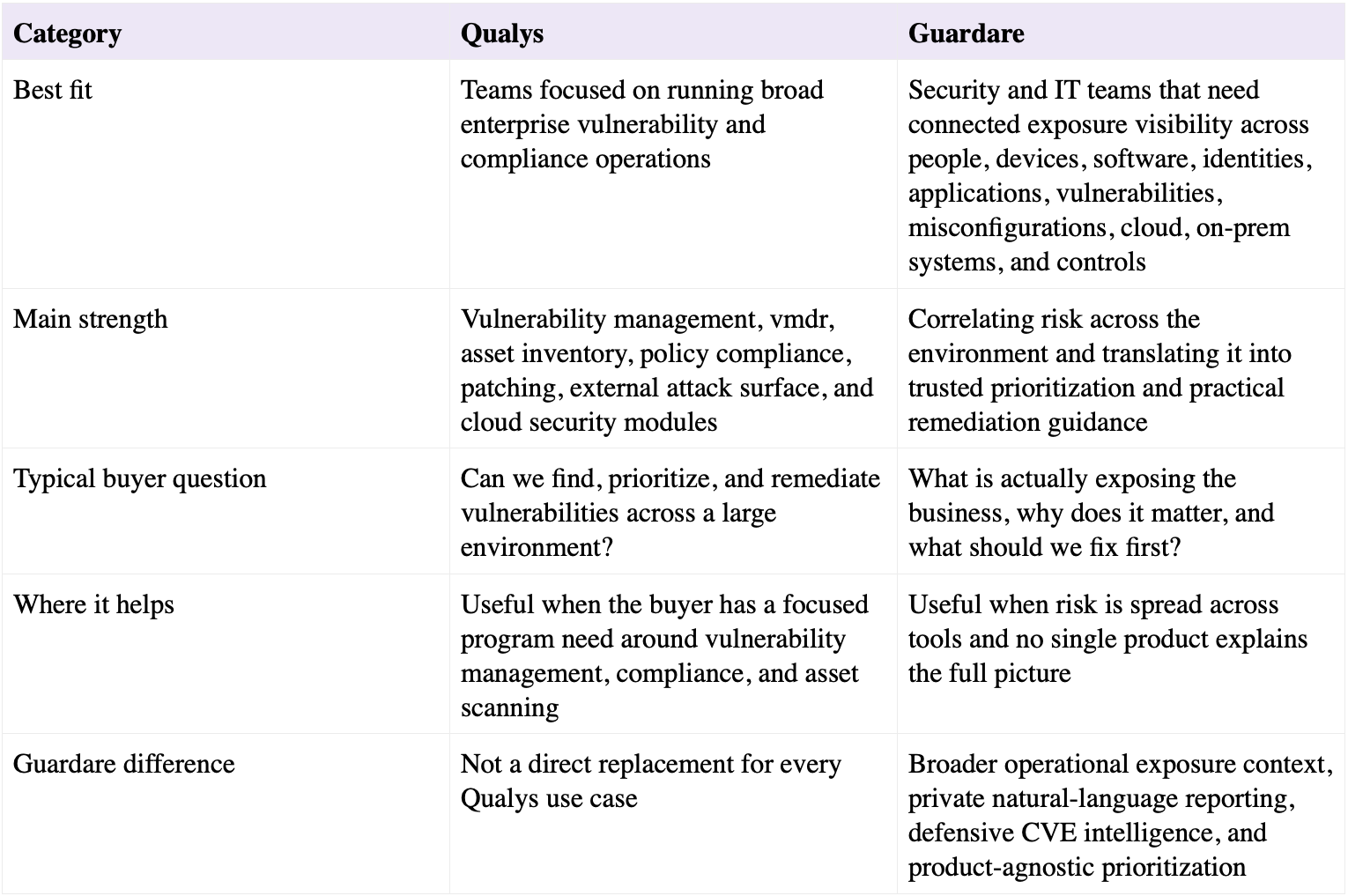
Qualys vs. Guardare

Qualys Exposure Management Alternatives

Exposure management is not just another name for vulnerability management. It is the work of connecting weaknesses, access, assets, software, controls, and business context into a practical remediation priority.

In real environments, exposure can come from:

  • Unmanaged or poorly protected devices
  • Risky users and stale accounts
  • Vulnerable or unsupported software
  • Cloud and on-prem misconfigurations
  • SaaS applications with broad permissions
  • Weak or missing identity controls
  • Security tools deployed but not enforcing
  • External attack surface exposure
  • Ownership gaps that slow remediation

Guardare as a Qualys Alternative

Guardare should be evaluated when the buyer wants more than a vulnerability management, compliance, and asset scanning point solution. It helps teams connect the operational details that usually live in separate tools: users, devices, software, identity, cloud, on-prem assets, SaaS applications, vulnerabilities, misconfigurations, and control coverage.

Plain-English reporting is useful only if the data stays controlled. Guardare is designed so customers can query their own exposure data inside a trusted system and avoid sending asset, identity, vulnerability, or control details into public AI tools.

Guardare treats CVE intelligence as a live input, not a static export. That helps teams understand which emerging issues are relevant to their actual software, devices, users, and control coverage.

That is where the always-on advisor concept matters. Guardare continuously looks for fixable risk across the environment and helps separate urgent exposure from ordinary background noise.

Qualys Security Operations, Risk, and Remediation Alternatives

Some buyers compare Qualys with platforms in adjacent categories. That can include vulnerability management, external attack surface management, SIEM, XDR, MDR, security validation, workflow automation, cyber risk quantification, or remediation tools.

Guardare should not be forced into every one of those buckets. It answers a different question. A scanner may show what is vulnerable. An MDR provider may show what happened. A workflow platform may route tickets. A validation platform may prove a path works. Guardare helps explain the exposure conditions before they turn into an incident or an endless queue of tickets.

In many cases, Guardare complements the tools already deployed. It gives those tools shared context so the team can understand what the combined security environment is really saying.

When Qualys May Still Be the Right Fit

  • Your main problem is specifically running broad enterprise vulnerability and compliance operations.
  • Your team already has a working process built around Qualys.
  • Qualys is already adopted and producing measurable value.
  • The organization needs a category-specific capability more than a broader exposure layer right now.
  • Switching would create more operational friction than benefit.

When Guardare Is the Better Fit

  • You want to see how users, devices, software, identity, applications, cloud, on-prem systems, and controls combine into exposure.
  • You want plain-English reporting inside a trusted customer-specific system, not public AI prompts.
  • You need vulnerability urgency evaluated continuously against your real environment.
  • You need always-on exposure monitoring that turns signals into practical guidance.
  • You have too many findings and not enough clarity.
  • You need a practical way to separate urgent exposure from background noise.
  • You need reporting that leadership can understand without reading scanner exports.
  • You want exposure context across existing platforms rather than another rip-and-replace project.

How to Evaluate Qualys Alternatives

  • Does the platform explain exposure, or does it mainly produce findings, alerts, scores, or tickets?
  • Can it connect people, devices, software, identities, applications, vulnerabilities, cloud, on-prem systems, and controls?
  • Does it work with the tools you already use, or does it require a broader platform switch?
  • Can teams ask natural-language questions about their own environment in a trusted system?
  • Does it evaluate new CVE intelligence against your actual assets and controls?
  • Can it identify underused tools, misconfigurations, and missing enforcement?
  • Does it help operators decide what to fix first?
  • Can executives understand the reporting without needing another technical export?
  • Will it reduce time and cost, or simply create another dashboard to manage?

Best Qualys Alternatives FAQ

What is the best Qualys alternative?
The best Qualys alternative depends on the problem. If the goal is running broad enterprise vulnerability and compliance operations, Qualys may still be useful. If the goal is connected exposure management across people, devices, software, identities, vulnerabilities, misconfigurations, cloud, on-prem systems, and controls, Guardare should be evaluated.
Is Guardare a Qualys replacement?
Guardare can replace or complement parts of a Qualys-centered workflow depending on the environment. It should not be described as a one-for-one replacement for every Qualys use case. Guardare is strongest when the buyer wants broader exposure context and prioritization across the tools already in place.
How is Guardare different from Qualys?
Qualys is usually evaluated for vulnerability management, VMDR, asset inventory, policy compliance, patching, external attack surface, and cloud security modules. Guardare is focused on explaining exposure across the whole environment, including people, devices, software, identities, cloud, on-prem assets, SaaS applications, vulnerabilities, misconfigurations, and security controls.
Can Guardare work alongside Qualys?
No. Guardare is a direct competitor in this category. While Guardare can ingest data from existing security tools, it is not positioned as a simple add-on to another exposure management platform. Guardare is built to replace the need for separate exposure correlation, prioritization, reporting, and remediation workflows by giving teams one connected view across users, devices, software, identity, vulnerabilities, and security controls. In some environments, Guardare may still coexist with parts of the existing stack. But the goal is not to make a competing platform easier to use. The goal is to give organizations a clearer, more actionable way to manage exposure without relying on another disconnected dashboard.
Why does private natural-language reporting matter?
Security teams often need fast answers, but they should not have to paste sensitive asset, identity, vulnerability, and control data into public AI tools. Guardare gives teams a way to query their own environment in a trusted, closed system.