Guardare Announces Strategic Partnership with Virtuo Group to Support Texas Department of Information Resources (DIR) Contract
Read More ->.svg)


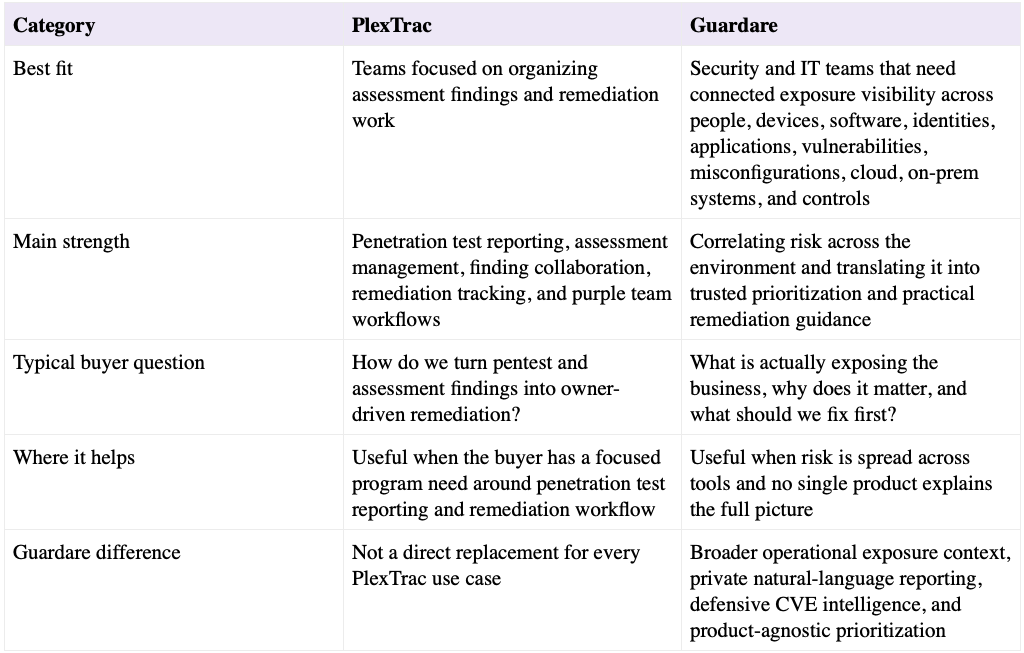
PlexTrac is often evaluated for pentest reporting, findings management, and remediation workflow. Buyers look at alternatives when they need live exposure context across the environment.
A pentest report is valuable, but the environment changes. New CVEs, new users, new SaaS access, and changing device posture can make yesterday’s priorities incomplete.
Peer discussions around reporting platforms often include templates, workflow, integrations, ease of use, and how well stakeholders consume the reports.
A ticket queue can track work, but it still needs a reliable way to decide which issues deserve attention first.
PlexTrac may fit report management. Broader alternatives come up when teams want a trusted advisor that watches people, devices, software, and controls every day.
PlexTrac can be the right tool when a team has a focused problem around organizing assessment findings and remediation work.
The hard part is rarely finding one issue. It is understanding how that issue connects to the rest of the environment. A CVE, stale account, exposed app, missing control, or unmanaged endpoint may look ordinary by itself. Together, those conditions can create a real path for an attacker.
That is where Guardare fits.
Guardare helps organizations read the environment as one connected system instead of a pile of separate dashboards. It looks across users, devices, software, identities, SaaS applications, vulnerabilities, cloud, on-prem infrastructure, and controls to explain where exposure is coming from.
Best for: Security and IT teams that want one exposure view across people, devices, software, identity, applications, vulnerabilities, cloud, on-prem systems, misconfigurations, and existing controls.
PlexTrac is usually evaluated when the buyer is focused on organizing assessment findings and remediation work. Guardare starts with a broader operating question: what is actually exposing the organization, how do those conditions connect, and what should be fixed first?
The point is not to collect more findings. It is to understand whether a vulnerability, user, device, software package, application, identity condition, or missing control is creating real exposure.
Guardare is not a workflow automation platform in the same way PlexTrac may be evaluated. It helps determine what deserves action and why, then can support the workflows and tools the customer already uses.
Best for: Organizations building a cyber risk management and remediation operations program.
Brinqa belongs in evaluations where teams need to aggregate findings, score risk, and route remediation work across owners.
Workflow and scoring help, but buyers should test whether the platform explains exposure in plain language for both operators and executives.
Best for: Teams that need one place to centralize and prioritize findings from multiple vulnerability scanners.
Nucleus is often evaluated by mature VM teams that already have many scanners and need aggregation, deduplication, and remediation tracking.
Vulnerability operations are important, but many exposures do not begin as scanner findings. Identity, SaaS, device posture, and control gaps still matter.
Best for: Large organizations already using ServiceNow for ITSM, CMDB, ownership, and remediation routing.
ServiceNow comes up when the buyer wants security work to move through enterprise workflows and existing IT processes.
ServiceNow can route work well, but remediation quality depends on the context and prioritization that exist before the ticket is created.
Best for: Security teams building flexible automation workflows across security and IT tools.
Tines is relevant when teams want to automate enrichment, routing, notifications, and response steps without heavy engineering.
Automation is only as good as the context feeding it. Bad prioritization just creates faster noise.
Best for: Teams using automation and AI to accelerate security operations work.
Torq comes up when buyers want to automate investigation, response, and security workflows across the stack.
Automation helps teams move faster, but exposure context determines whether they are working on the right issues.
Best for: Teams that want to safely validate exploitable attack paths in their environment.
Pentera belongs in evaluations when the buyer wants autonomous validation and proof that an attack path can be exploited.
Exploitability proof is powerful, but many teams also need continuous exposure cleanup across identities, devices, software, SaaS, and controls.
A useful exposure program looks at the combinations attackers can use. That means vulnerabilities, identities, devices, applications, cloud, on-prem systems, permissions, and controls have to be read together.
In real environments, exposure can come from:
Guardare should be evaluated when the buyer wants more than a penetration test reporting and remediation workflow point solution. It helps teams connect the operational details that usually live in separate tools: users, devices, software, identity, cloud, on-prem assets, SaaS applications, vulnerabilities, misconfigurations, and control coverage.
Guardare also gives teams a safer way to use AI for reporting. Security leaders and operators can ask questions about users, devices, software, controls, CVEs, and exposure inside a closed customer-specific system. Sensitive environment data does not need to be pasted into a public model.
The CVE side matters because vulnerability urgency changes fast. Guardare is meant to continuously compare new vulnerability intelligence against what the customer actually runs, who uses it, where it sits, and what controls are in place.
Instead of handing teams another massive list, Guardare is built to reduce the list. It points to the users, devices, software, controls, and misconfigurations that deserve attention now.
Some buyers compare PlexTrac with platforms in adjacent categories. That can include vulnerability management, external attack surface management, SIEM, XDR, MDR, security validation, workflow automation, cyber risk quantification, or remediation tools.
Guardare should not be forced into every one of those buckets. It answers a different question. A scanner may show what is vulnerable. An MDR provider may show what happened. A workflow platform may route tickets. A validation platform may prove a path works. Guardare helps explain the exposure conditions before they turn into an incident or an endless queue of tickets.
That makes Guardare useful in mixed environments where cloud, on-prem systems, endpoint tools, identity platforms, scanners, and ticketing systems all tell different parts of the story.
