Guardare Announces Strategic Partnership with Virtuo Group to Support Texas Department of Information Resources (DIR) Contract
Read More ->.svg)


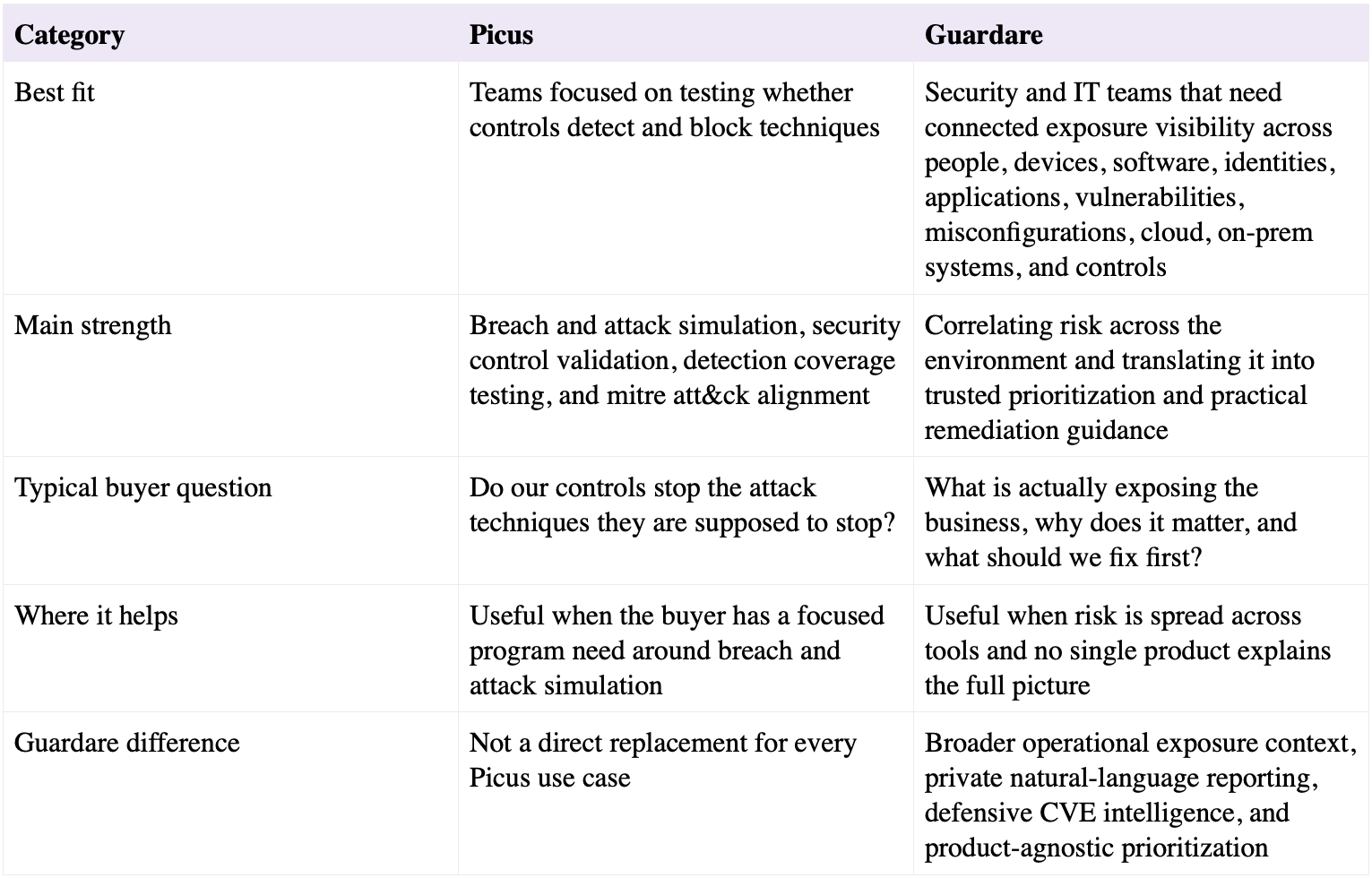
Picus can be the right tool when a team has a focused problem around testing whether controls detect and block techniques.
A finding becomes more important when it touches a critical user, an unmanaged asset, exposed software, weak access, or a missing control. That context is often scattered across systems. Guardare is meant to bring it together.
That is where Guardare fits.
Guardare gives security and IT teams a product-agnostic exposure layer across the tools they already own. The goal is not another console full of findings. The goal is a trusted view of what matters, why it matters, and what should happen next.
Picus is often evaluated for breach and attack simulation and detection validation. Buyers look at alternatives when they need to connect failed controls to the users, devices, software, and identities behind them.
Knowing a control missed a technique is useful, but teams still need to know which environment conditions made that miss dangerous and what action reduces risk.
Peer conversations around BAS tools often include test coverage, false positives, ease of interpreting results, and whether findings translate into practical remediation.
Without broader exposure prioritization, control validation may add more issues to already overloaded teams.
Picus may fit control testing. Broader alternatives come up when teams want continuous exposure management across people, devices, software, cloud, and on-prem systems.
Best for: Security leaders who need to connect technical findings to business risk across users, devices, software, identities, applications, controls, and existing platforms.
Picus is usually evaluated when the buyer is focused on testing whether controls detect and block techniques. Guardare starts with a broader operating question: what is actually exposing the organization, how do those conditions connect, and what should be fixed first?
Guardare treats vulnerabilities as one signal among many. User risk, device posture, software exposure, identity access, SaaS permissions, misconfigurations, and tool coverage all change the priority.
Guardare is not trying to replace every product in the security stack. It is designed to work across those tools and explain exposure in a way operators, IT teams, and executives can act on.
Best for: Teams that want to test controls against attack techniques and improve detection coverage.
SafeBreach belongs in evaluations where continuous validation and attack technique testing are central.
A failed simulation is useful, but the team still needs asset, identity, software, and ownership context to fix the right thing first.
Best for: Teams that want exposure validation and security control testing.
Cymulate is relevant when buyers want a programmatic way to test how controls respond to attacker behavior.
Control testing should feed a broader exposure program, not sit in a separate lane that operators must interpret manually.
Best for: Security teams focused on breach and attack simulation and control validation.
AttackIQ comes up when detection engineering, control testing, and adversary emulation are the buyer priorities.
Attack simulation can show what controls miss, but it does not by itself explain everyday risk across people, devices, software, and access.
Best for: Teams that want to safely validate exploitable attack paths in their environment.
Pentera belongs in evaluations when the buyer wants autonomous validation and proof that an attack path can be exploited.
Exploitability proof is powerful, but many teams also need continuous exposure cleanup across identities, devices, software, SaaS, and controls.
Best for: Teams focused on detection posture, SIEM rule coverage, and MITRE mapping.
CardinalOps comes up when detection coverage and SIEM effectiveness are the core concerns.
Detection coverage is important, but it should be tied to the exposures that make specific threats more likely or more damaging.
Best for: Teams focused on security control optimization and getting more value from existing tools.
Reach Security is relevant when the buyer wants to tune current controls instead of buying yet another detection product.
Control tuning matters, but buyers should ensure the platform also connects findings to people, devices, software, SaaS, identity, and business risk.
Exposure management helps teams answer a simple question that is hard to answer with separate tools: what are we exposed to, why does it matter, and what should we fix first?
In real environments, exposure can come from:
Guardare should be evaluated when the buyer wants more than a breach and attack simulation point solution. It helps teams connect the operational details that usually live in separate tools: users, devices, software, identity, cloud, on-prem assets, SaaS applications, vulnerabilities, misconfigurations, and control coverage.
Plain-English reporting is useful only if the data stays controlled. Guardare is designed so customers can query their own exposure data inside a trusted system and avoid sending asset, identity, vulnerability, or control details into public AI tools.
Attackers use automation to move quickly from new vulnerability information to exploitation. Guardare helps defenders answer the opposite question just as quickly: does this new issue matter here, and what should we do about it?
The practical outcome is a smaller work queue. Guardare is meant to behave like a trusted security advisor that never stops watching. It calls out fixable exposure, explains why it matters, and helps teams spend time on the few actions that reduce the most risk.
Some buyers compare Picus with platforms in adjacent categories. That can include vulnerability management, external attack surface management, SIEM, XDR, MDR, security validation, workflow automation, cyber risk quantification, or remediation tools.
Guardare should not be forced into every one of those buckets. It answers a different question. A scanner may show what is vulnerable. An MDR provider may show what happened. A workflow platform may route tickets. A validation platform may prove a path works. Guardare helps explain the exposure conditions before they turn into an incident or an endless queue of tickets.
That makes Guardare useful in mixed environments where cloud, on-prem systems, endpoint tools, identity platforms, scanners, and ticketing systems all tell different parts of the story.
