Guardare Announces Strategic Partnership with Virtuo Group to Support Texas Department of Information Resources (DIR) Contract
Read More ->.svg)


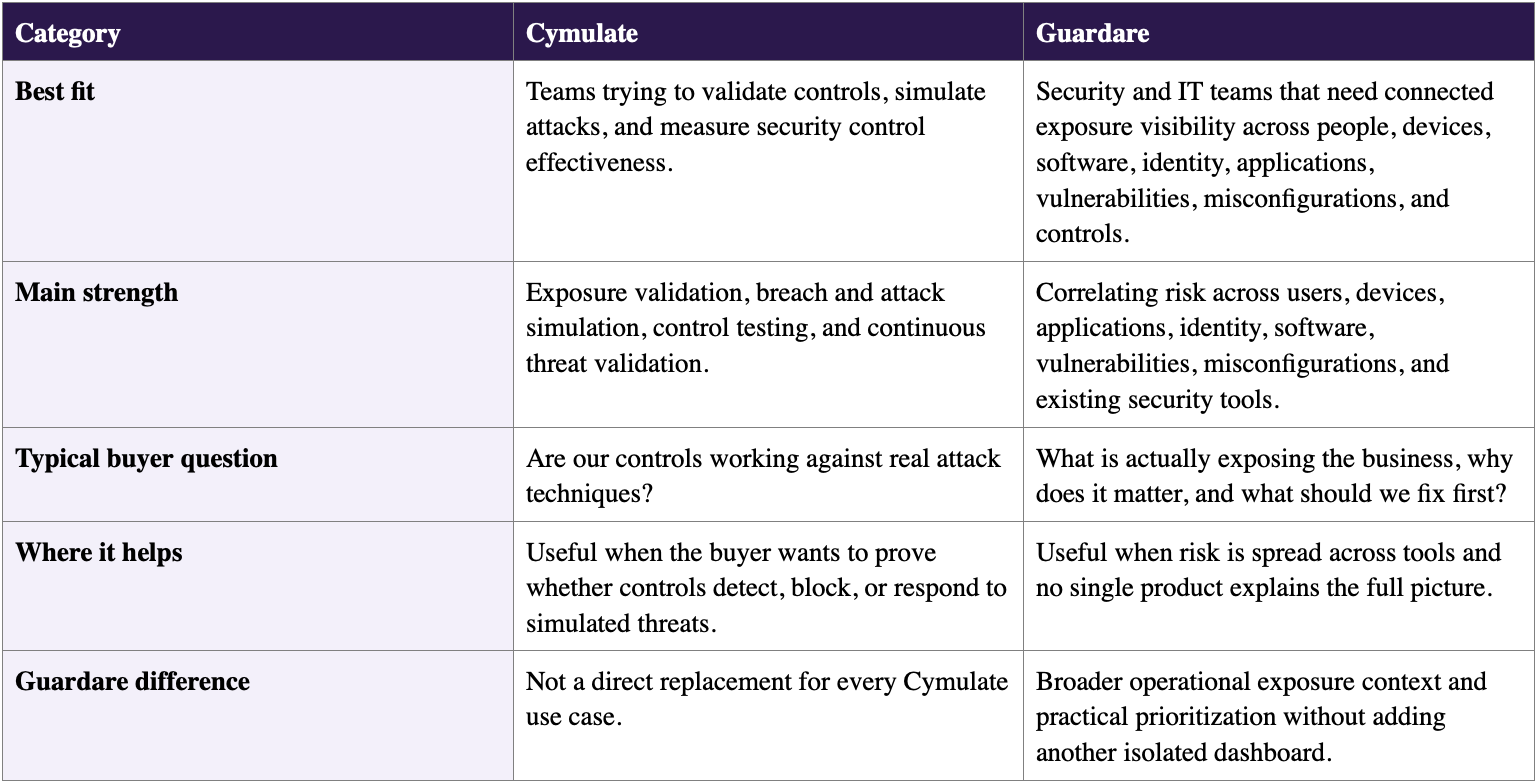
Cymulate is a well-known name in exposure validation, breach and attack simulation, automated security validation, continuous threat validation, and security control testing. Many organizations look at Cymulate when they want to test whether their defenses can detect, block, or respond to real-world attack techniques.
That can be a real need.
Security teams should know whether their controls work. They should know whether an attack simulation reaches a target. They should know whether a detection fires, whether a playbook runs, and whether a control needs tuning.
But the exposure management conversation has moved beyond one category.
Teams are no longer only asking whether a simulated attack succeeded or failed. They are asking what that result means across the rest of the environment.
They are asking better questions:
That is where Guardare fits.
Guardare is an AI-powered Unified Exposure Management platform built to help organizations understand risk across users, devices, applications, identity, software, misconfigurations, vulnerabilities, and existing security tools. It does not try to replace every tool in the stack. It helps explain what all of those tools mean together.
Cymulate can be a strong option for exposure validation, breach and attack simulation, security control validation, and continuous threat validation. Buyers often look at alternatives when the problem starts to stretch beyond validation alone.
A failed control test is useful. It tells the team something did not work as expected.
But the next question matters just as much.
What is behind the failure?
A missed detection may be tied to an endpoint policy gap, unmanaged device, stale identity, exposed application, missing EDR enforcement, weak cloud configuration, or software issue. If those signals live in different tools, the team may still have to manually piece together the real exposure.
Guardare helps connect those signals so teams can understand the exposure, not just the validation result.
Breach and attack simulation can show whether a control reacts to a specific technique, payload, or path. That is valuable.
But attackers do not operate inside one report.
They chain weak identity controls, unmanaged devices, risky applications, exposed services, misconfigurations, and missing enforcement. A simulation may show one part of that chain. Exposure management needs to show how the chain connects across the environment.
Guardare is built around that broader connection.
A validation platform can produce useful findings, but teams still need to decide what to do first.
A control failure on a low-value segment may not deserve the same urgency as a weaker issue tied to a privileged user, unmanaged device, exposed app, or business-critical system. Priority changes when identity, device posture, application access, software risk, and control coverage are added.
Guardare helps prioritize based on context, not just validation status or severity.
Most companies are not starting from zero. They already have endpoint tools, identity systems, cloud platforms, scanners, firewalls, SaaS applications, ticket queues, email security, and dashboards.
The issue is that each tool tells a different story.
Guardare helps turn those disconnected stories into one exposure view.
Executives do not need another technical export. They need to understand where the business is exposed, what is driving the risk, and what action will reduce it.
Validation data can support that conversation. But it often needs to be translated into broader business exposure.
Guardare helps security and IT teams explain exposure in a way that is easier for leadership to understand.
Best for: Organizations that want unified exposure management across users, devices, applications, identity, software, misconfigurations, vulnerabilities, and security tools.
Cymulate is known for exposure validation, breach and attack simulation, continuous threat validation, and security control testing. Guardare starts with a different question: what is actually exposing the organization?
Guardare is not positioned as a traditional BAS, SIEM, EDR, patch management, or MDR replacement. It is best suited for organizations that want exposure visibility, prioritization, and decision support across the tools they already use.
Best for: Teams that want breach and attack simulation, detection validation, and security control testing.
Picus often comes up in Cymulate comparisons because both platforms are commonly evaluated for BAS, control validation, MITRE-style testing, and measuring whether security controls detect or block attack techniques.
Picus helps validate defenses, but buyers should still understand the user, device, application, identity, and software exposure behind the failed control or missed detection.
Best for: Teams that want to test controls against attack techniques and validate how defenses perform.
SafeBreach is often evaluated when teams want continuous security validation, attack simulation, and evidence that defenses work against known techniques.
SafeBreach helps validate controls, but buyers should still connect failures to the operational exposures that created the risk.
Best for: Teams that want automated security validation, automated penetration testing, exploitability proof, and attack path validation.
Pentera often comes up when buyers want a more adversarial testing lens. It is usually evaluated for validating exploitability and showing how attacks could progress through an environment.
Pentera can help prove attack paths, but many teams also need broader day-to-day exposure context across users, devices, applications, identity, software, and controls.
Best for: Security teams focused on breach and attack simulation, purple teaming, control validation, and adversary emulation.
AttackIQ is often considered by teams that want structured security control validation and adversary emulation programs aligned to known attacker behavior.
AttackIQ helps teams test defensive performance, but the surrounding exposure context still matters when deciding what to fix first.
Best for: Teams trying to understand how attackers could chain exposures to reach critical assets.
XM Cyber comes up when buyers want attack path management and a better view of how identity, cloud, endpoint, and network exposures can connect to critical assets.
XM Cyber helps show paths, but many teams also need operational exposure cleanup across users, devices, software, SaaS applications, misconfigurations, and existing controls.
Best for: Teams that want autonomous penetration testing and proof of exploitable risk.
Horizon3.ai often comes up when buyers want to continuously validate exploitable weaknesses through autonomous pentesting rather than traditional scan results alone.
Autonomous pentesting can prove exploitability, but buyers still need a broader exposure layer that connects those results to users, devices, applications, identity, software, controls, and business risk.
Exposure management is the practice of identifying, understanding, prioritizing, and reducing the weaknesses that create real risk. That includes vulnerabilities, but it also includes more than vulnerability data.
It can include:
Guardare helps teams move from isolated validation results to unified exposure management.
Instead of asking teams to manually connect attack simulation results, asset scans, user data, device posture, SaaS findings, identity context, software risk, and security tool outputs, Guardare brings those pieces into one risk model.
Guardare is especially useful for teams that want to understand:
Some buyers compare Cymulate with platforms in adjacent categories. That can include breach and attack simulation, automated penetration testing, adversarial exposure validation, external attack surface management, vulnerability management, SIEM, XDR, MDR, workflow automation, cyber risk quantification, or remediation tools.
Guardare should not be positioned as a direct replacement for every one of those categories.
Instead, Guardare helps answer a different question.
A BAS platform may show whether a control failed. A scanner may show what is vulnerable. A SIEM may show what happened. An MDR provider may help investigate activity. A workflow platform may route tickets. Guardare is focused on understanding exposure before it turns into an incident.
The tools can work together. Detection and response tools can show what is happening. Validation platforms can show whether controls perform. Guardare can help reduce the conditions that make incidents more likely.
Cymulate may be a strong fit when:
Guardare is a better fit when:
When comparing Cymulate competitors, ask:
