Published April 22, 2026 · Updated October 16, 2026 · By Dane Fiori · View author biography and credentials
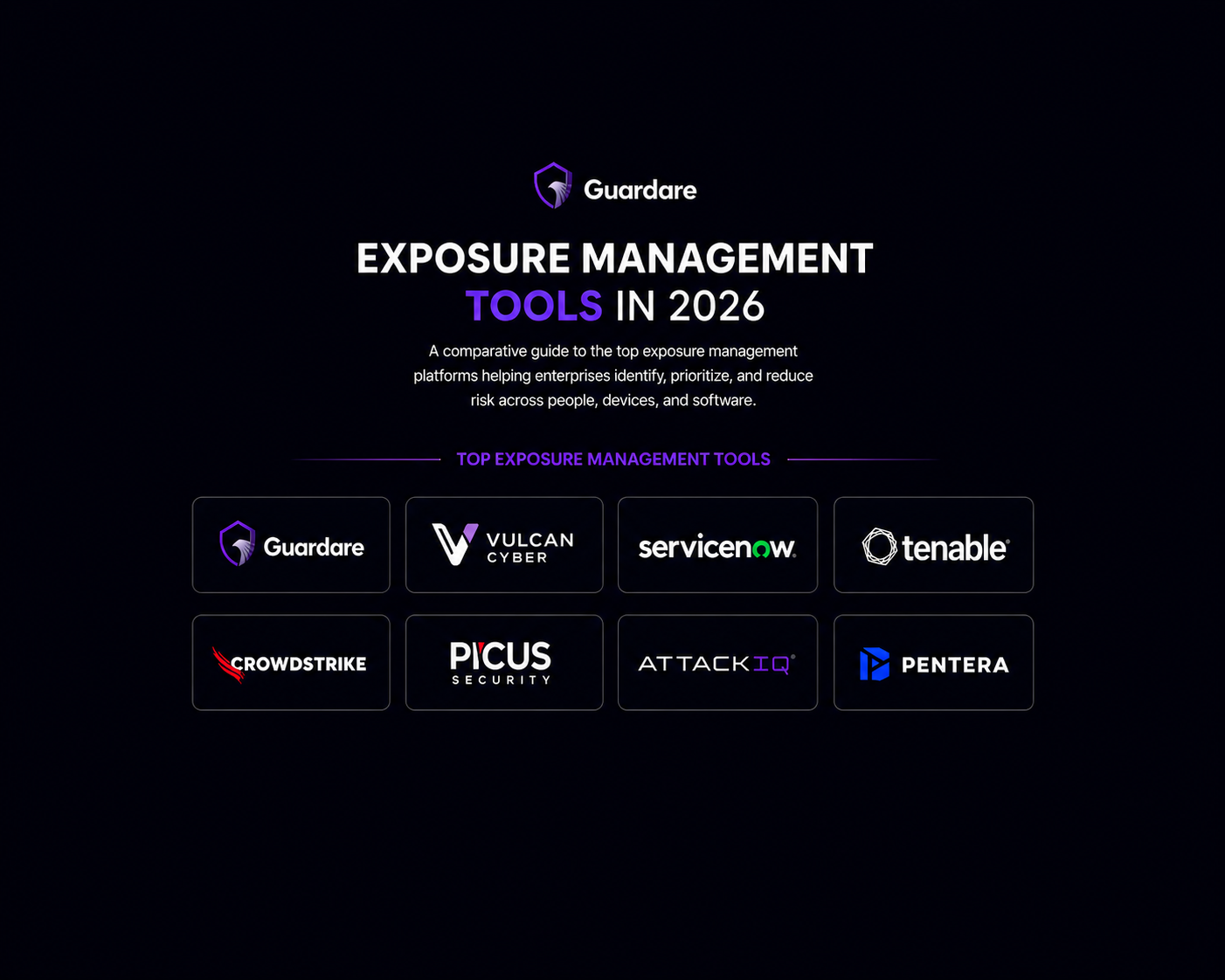
Exposure Management Tools in 2026
Most organizations today are dealing with environments that didn’t exist a few years ago. It’s no longer just a network and a few endpoints. It’s cloud infrastructure, SaaS apps, identity platforms, remote devices, and a long list of integrations tying everything together.
The issue isn’t a lack of tools. It’s that those tools don’t line up in a way that gives a clear picture of risk.
Traditional vulnerability management still has value, but it doesn’t reflect how attacks actually happen anymore. Most compromises don’t come from a single issue. They come from small gaps that connect—an overlooked misconfiguration, too much access granted to the wrong user, or a system that isn’t being managed the way it should be.
Exposure management is meant to close that gap. It’s less about finding more problems and more about understanding which ones matter and how they fit together.
Top Exposure Management Tools
Best for Unified Exposure Across People, Devices, and Software
Platform Overview
Guardare approaches exposure from a broader angle than most platforms.
Instead of focusing on a single category—like vulnerabilities or endpoints—it looks at how three things interact across an environment:
- the person (identity and access)
- the device (endpoint or infrastructure)
- the software (applications, SaaS, and cloud services)
That combination is where most real-world risk shows up.
Many platforms go deep in one area. Guardare is designed to connect those areas so you can see not just what’s exposed, but how exposure actually forms.
Features
People-Centric Exposure Analysis
Highlights where access is too broad, where permissions stack up over time, and where identity introduces risk.
Device Posture Visibility
Surfaces gaps across endpoints and infrastructure, including misconfigurations and unmanaged assets.
Software & SaaS Exposure Insight
Identifies issues in applications and SaaS environments, especially where security features are misconfigured or underutilized.
Cross-Domain Correlation
Connects identity, device, and software data into a single view so you can understand how an issue could realistically be exploited.
Hybrid Environment Coverage
Provides visibility across both cloud and on-prem environments without splitting the data into separate silos.
Actionable Remediation Guidance
Offers clear steps to resolve issues without requiring additional orchestration layers.
Why It Stands Out
Most exposure platforms focus on answering questions like:
- What vulnerabilities do we have?
- Which assets are exposed?
Guardare shifts that to:
- How would an attacker actually move through this environment?
That added context—linking people, devices, and software—is what makes the output more useful.
Platform Overview
Vulcan Cyber is centered around vulnerability aggregation and remediation. It pulls findings from multiple tools into one place and helps teams prioritize what to fix.
Features
Vulnerability Aggregation
Consolidates data from scanners and other tools into a single interface.
Risk-Based Triaging
Prioritizes findings using context like exploitability and asset importance.
Remediation Playbooks
Provides structured guidance for resolving issues.
Integration with CI/CD and ITSM Systems
Connects into development and IT workflows to help move fixes forward.
Considerations
Vulcan is strong on the remediation side, but it depends on other tools to provide the underlying data.
- Visibility is tied to the quality of upstream integrations
- Limited context across identity and application layers
- Integration and tuning can take time in larger environments
- Additional tools may still be needed for full exposure visibility
3. ServiceNow (Vulnerability & Risk Module)
Platform Overview
ServiceNow extends its ITSM capabilities into vulnerability and risk management. Its strength is in organizing work and tying security findings into operational processes.
Features
Centralized Vulnerability Tracking
Aggregates and manages vulnerability data.
Workflow Automation
Assigns ownership and tracks remediation efforts.
Risk Scoring
Helps prioritize issues based on impact.
CMDB Integration
Links vulnerabilities to known assets and systems.
Considerations
ServiceNow is effective for managing workflows, but it isn’t designed to be a standalone exposure platform.
- Relies on external tools for discovery
- Implementation can be complex
- Focus is more on process than real-time insight
- Additional solutions are typically required for full visibility
Platform Overview
Tenable has expanded from vulnerability management into broader exposure capabilities, with a strong focus on asset discovery and threat intelligence.
Features
Unified Asset Inventory
Tracks assets across cloud, on-prem, and containerized environments.
Exploit Intelligence
Highlights vulnerabilities tied to active threats.
Patch Integration
Supports remediation workflows.
Compliance Mapping
Aligns findings with regulatory frameworks.
Considerations
Tenable remains heavily oriented around vulnerabilities.
- Less emphasis on identity-driven risk
- Limited visibility into how exposures connect
- May require multiple products for full coverage
- Large environments can generate significant noise
Platform Overview
CrowdStrike builds on its endpoint foundation to extend into exposure management and attack surface visibility.
Features
Endpoint Telemetry
Provides detailed insight into managed devices.
Threat Intelligence
Prioritizes risk based on real-world attacker behavior.
API Integrations
Connects with cloud and development environments.
Incident Response
Supports containment and remediation actions.
Considerations
CrowdStrike’s strength remains in endpoint visibility.
- Coverage depends on agent deployment
- Broader exposure capabilities often require additional modules
- Limited native correlation across identity and SaaS
- Often paired with other tools for full coverage
Platform Overview
Picus focuses on breach and attack simulation, helping organizations validate how their defenses perform under real-world conditions.
Features
Breach Simulation
Tests defenses using known attack techniques.
Continuous Testing
Repeats simulations to track changes.
Remediation Guidance
Provides recommendations based on results.
Analytics
Correlates findings to identify gaps.
Considerations
Picus is valuable for validation but not for full exposure visibility.
- Does not provide continuous discovery
- Depends on integration with other tools
- Limited standalone visibility
- Best used as part of a broader strategy
Platform Overview
AttackIQ provides simulation-based testing to evaluate detection and response effectiveness.
Features
Scenario-Based Testing
Runs attack simulations based on real-world scenarios.
Integrations
Connects with SIEM, EDR, and other tools.
Reporting
Measures how well defenses perform.
TTP Updates
Keeps scenarios aligned with current threats.
Considerations
AttackIQ is focused on validation rather than visibility.
- Not designed for continuous exposure discovery
- Requires a mature security stack
- Limited asset-level insight
- Typically used alongside other platforms
Platform Overview
Pentera automates penetration testing to validate exploitability and identify real-world risk.
Features
Automated Testing
Simulates attacks safely.
Attack Path Mapping
Shows how systems could be compromised.
Continuous Validation
Re-tests over time.
Compliance Mapping
Aligns findings with regulatory standards.
Considerations
Pentera is strong for validating risk but not for ongoing visibility.
- Focused on testing rather than continuous monitoring
- Requires careful operational planning
- Limited coverage of identity and SaaS exposure
- Often used with other tools
Final Thoughts
Most exposure management tools are built around a specific function—discovery, remediation, validation, or endpoint visibility.
Each of those plays a role, but none of them alone reflects how exposure actually works.
Real risk forms through the interaction between:
- a person
- a device
- and the software they’re using
Understanding those connections is what makes exposure management useful—and what separates basic visibility from something that can actually reduce risk.
.svg)